
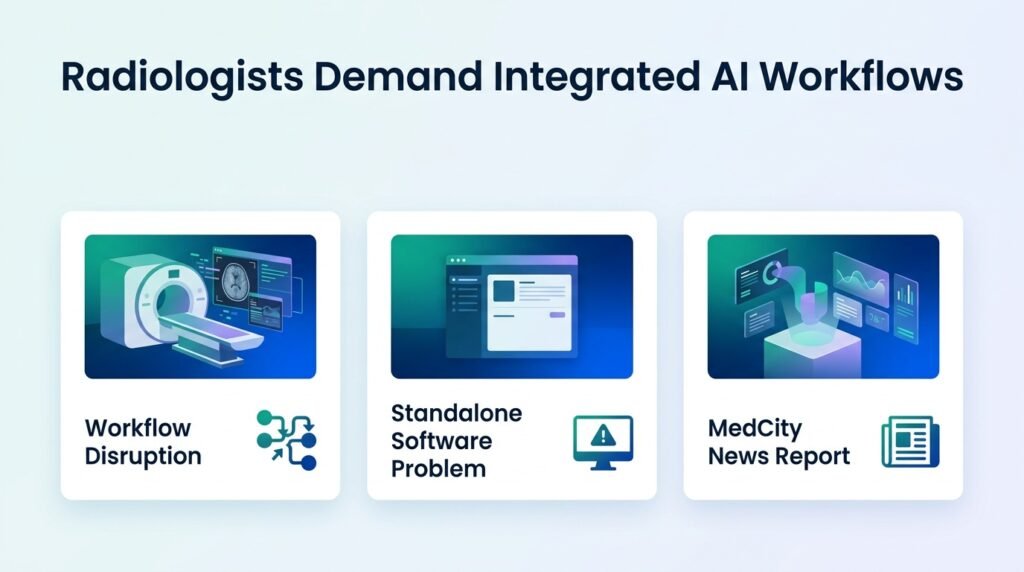
The flood of FDA-approved radiology AI is hitting a wall of clinical rejection because developers forgot a basic rule of medicine: do not disrupt the workflow.
Radiology accounts for roughly 80 percent of FDA-approved healthcare AI applications. Yet actual clinical adoption remains stubbornly low.
The reason is friction.
Radiologists are facing a severe global shortage and surging imaging volumes. Clinicians are already drowning in administrative tasks. Forcing them to toggle between disparate systems to view AI insights defeats the purpose of automation.
Every extra click is a liability.
The PACS Imperative
To survive in a high-pressure environment, AI must live where radiologists already work. That means direct integration into existing Picture Archiving and Communication Systems (PACS) using standard DICOM and HL7 protocols.
If an AI tool requires its own screen, it is dead on arrival.
This is not just a technical preference. It is a survival strategy for overstretched departments. Hospitals cannot afford to let software-induced fatigue slow down diagnostic times.
Consequently, health systems are shifting their buying habits. Instead of purchasing niche, isolated tools, they are turning to unified AI marketplaces and integrated platforms to automate triage.
The Workflow Standard
This shift signals a maturity phase for clinical AI. The era of selling algorithm accuracy alone is over.
The software that wins will not necessarily be the one with the highest standalone performance. It will be the one that disappears seamlessly into the clinician’s existing workflow.