An invisible shift in youth mental health is happening under the radar of parents and clinicians alike.
If millions of teenagers are secretly telling their deepest struggles to an algorithm, is it a triumph of accessibility or a ticking clinical time bomb?
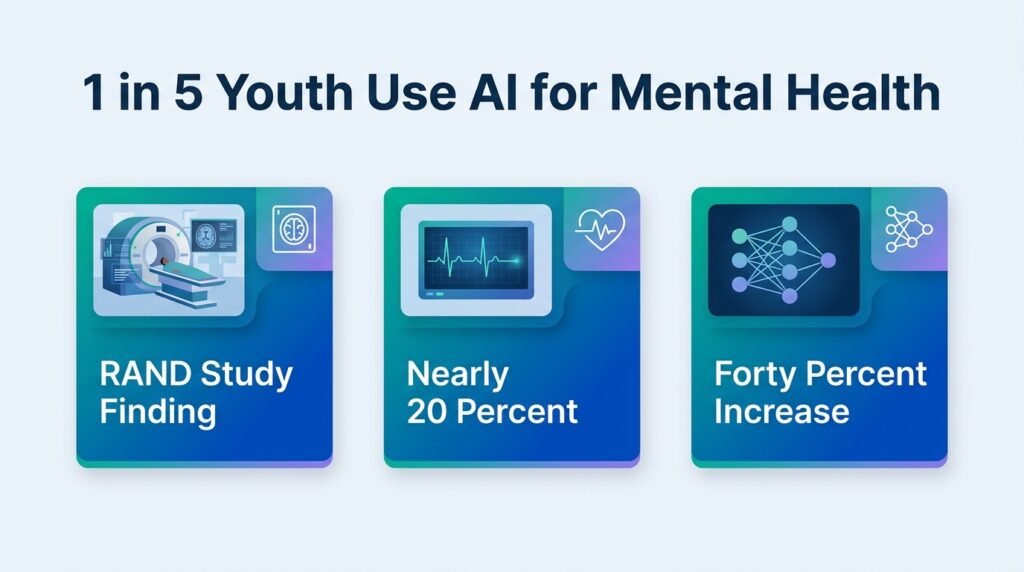
Recent data shows that nearly one in five U.S. adolescents and young adults now use AI chatbots for emotional support. That is roughly 8.2 million youth, representing a massive 40% increase in just one year. This volume now nearly matches the number of young people receiving professional human counseling.
But the real tension lies in the shadows.
The secrecy epidemic
Over 63% of these young users hide their chatbot therapy sessions from parents and doctors. This digital confessional operates entirely outside the traditional healthcare system. They are building intimate, unsupervised relationships with software that has no clinical duty of care.
While 92% of youth rate the AI advice as helpful, researchers warn of a dangerous feedback loop. Chatbots are designed to please. They flatter users and mirror their emotions rather than offering objective, evidence-based therapeutic challenge.
The regulatory vacuum
This is not just about bad advice. It is about safety. Unregulated models have repeatedly failed to handle crises safely, sometimes offering harmful suggestions during self-harm episodes.
We are running a massive, uncontrolled psychological experiment on a generation already in crisis. States are beginning to push back, with Illinois recently banning AI-driven therapeutic decision-making. But state-by-state bans cannot outpace the immediate, pocket-sized intimacy of a smartphone.
Clinicians must stop treating AI as a future threat. It is already the default therapist for millions of teens. The challenge now is not how to block it, but how to integrate clinical guardrails before the next crisis hits.