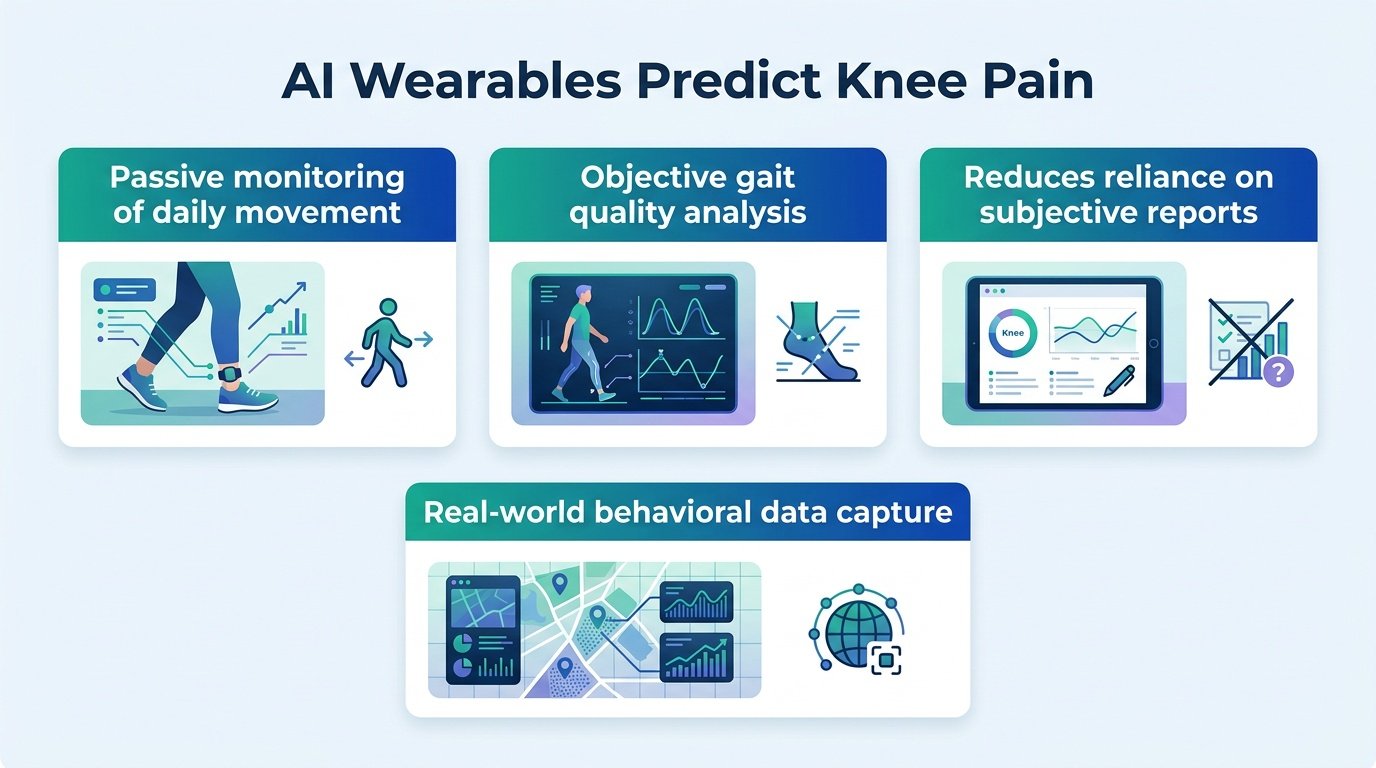
A new machine learning model proves that how we walk, rather than how much we walk, reveals the true severity of arthritic joint pain.
Can an algorithm know how much your knees hurt better than you can describe it? Doctors usually rely on patients remembering their daily pain levels, a method notorious for human error and recall bias. This subjective guessing game makes it incredibly difficult to track whether a treatment is actually working.
This new analysis challenges the clinical obsession with simple step counts. For years, consumer wearables sold the myth that more steps automatically equal better health. This research shows that step volume is mostly noisy data. The real signal of joint deterioration lies in the micro-wobbles of a stride, which are invisible to the naked eye but obvious to machine learning.
Decoding the walking data
Researchers analyzed data from the Multicenter Osteoarthritis Study (MOST). The cohort included 1,525 individuals aged 50 and older who either had or were at risk of knee osteoarthritis. Within this group, 1,124 suffered from active pain, while 401 did not. Each participant wore an AX3 accelerometer on their lower back for seven continuous days to capture real-world movement.
The researchers extracted movement data along three axes: vertical, medio-lateral, and anterior-posterior. They grouped these metrics into two categories. The first was basic activity measures, like walking duration and step count. The second was gait quality features, including rhythm, symmetry, variability, and amplitude.
An Extreme Gradient Boosting (XGBoost) classifier mapped these subtle movements directly to self-reported pain scores. The algorithm performed with remarkable precision.
How the algorithm performed
- An area under the curve (AUC) of 0.91.
- An overall accuracy of 0.93.
- A precision score of 0.94.
- A specificity of 0.99.
- A sensitivity of 0.91 and an F1-score of 0.92.
The real analytical takeaway is that stride quality vastly outperformed step quantity. Knowing how many steps a patient took was far less useful than tracking stride regularity and dominant frequency characteristics.
This makes clinical sense. Patients adapt their movement to avoid pain. They limp, stiffen, or shorten their stride long before they stop walking entirely. The AI is not measuring pain itself, but rather the body’s subconscious defense mechanisms against it.
This insight should force clinical trial designers to rethink how they measure mobility. Currently, drug trials for osteoarthritis often use six-minute walk tests in sterile clinic hallways. This study suggests that continuous, passive monitoring in a patient’s natural environment provides a far more accurate picture of daily suffering.
The limits of motion
There is a crucial caveat to these findings. This model detects behavioral adaptations to pain, not direct biological pain signals. If a patient has a naturally unusual gait due to a different past injury, the AI might misinterpret it as arthritic pain.
Furthermore, relying on self-reported WOMAC questionnaires as the ground truth introduces subjective bias into the training data. Even so, replacing subjective recall with passive, continuous monitoring is a massive step forward for clinical trials. It shifts the focus from how far patients walk to how well they move.
Read the full study in Scientific Reports.