Home PC runs AI that beats clinical radiologists
A new study shows that a consumer-grade computer running an LLM agent can build world-class medical AI without elite engineering teams.
Can a standard home computer build better medical AI than a team of elite software engineers? For years, the healthcare industry assumed that cutting-edge diagnostics required massive server farms and millions of dollars. A new preprint challenges this entire economic model.
This shift is not just about cheaper tech. It is about control. If clinical departments can customize their own diagnostic tools locally, the monopoly of big tech vendors in hospital software might be over.
The power of local agents
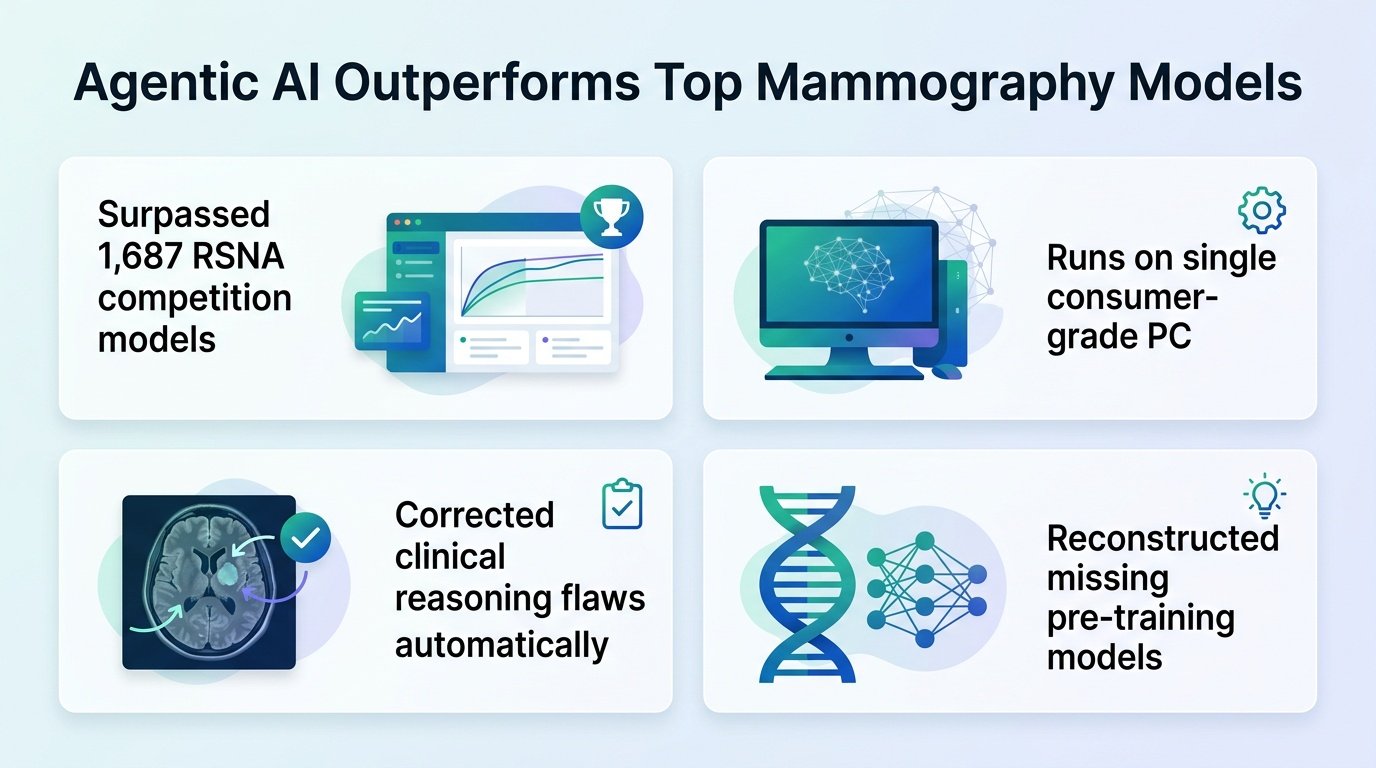
Researchers developed a large language model (LLM) agentic framework that reconstructs and optimizes deep-learning systems on a single consumer PC. To test it, they had the agent rebuild a flawed mammography workflow. The agent successfully reconstructed a missing pre-training model and corrected a clinical reasoning flaw in the code.
The resulting model did not just work. It dominated.
- The system surpassed all 1,687 submitted models in the RSNA Breast Cancer AI Challenge.
- It demonstrated robust generalizability with an AUC of 0.9 across international datasets of over 13,000 patients from the US and China.
- In a reader study of over 1,200 cases, the model outperformed human radiologists by an absolute AUC margin of 24% on extended follow-up.
Why this matters
This finding challenges the belief that clinical AI must be a static, commercial product. When a hospital buys a commercial AI, they are stuck with its biases. If local clinicians can use an LLM agent to retrain and correct reasoning flaws on a cheap PC, they can adapt the software to their specific patient demographic in real-time.
It democratizes performance. A small community clinic could theoretically deploy a breast cancer screening tool that performs at the level of an elite research institution, without needing an in-house data science team.
The limitations to watch
We must look at the hurdles. This study focused on mammography, which relies on highly structured imaging data. It remains to be seen if agentic frameworks can handle messier clinical workflows, like multi-modal ICU data.
Furthermore, letting clinicians modify diagnostic code locally raises massive regulatory questions. Agencies like the FDA typically approve static, locked software versions. If the code is constantly being optimized on a local PC, proving safety and maintaining compliance becomes a moving target.
Read the full study on medRxiv.