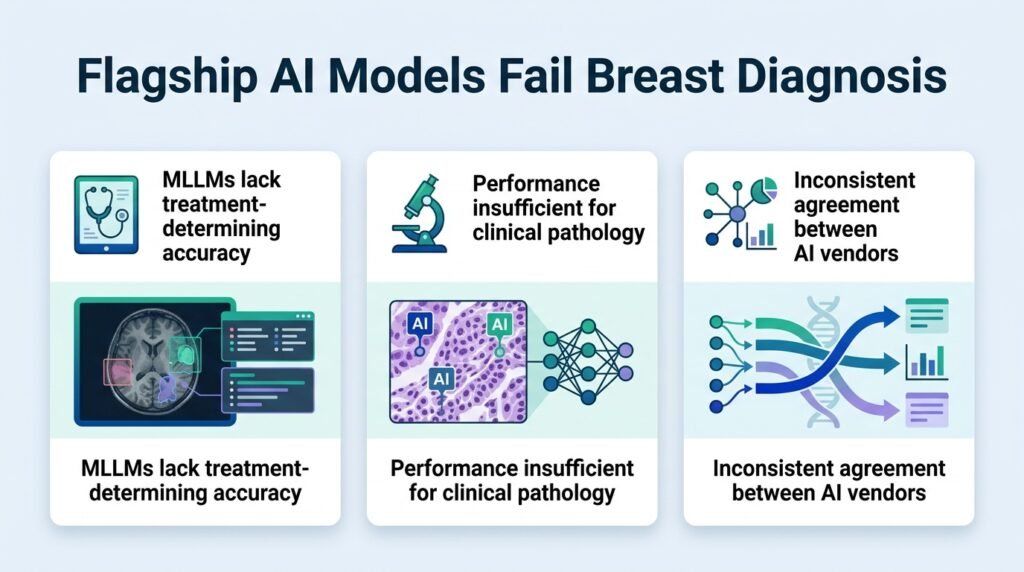
Hiring a commercial AI to read breast cancer biopsies does not just introduce errors; it forces clinicians to choose which specific flavor of diagnostic failure they can tolerate.
Can we trust off-the-shelf AI models to make life-or-death cancer decisions? Many hope these systems can bypass the global shortage of specialist pathologists. A new evaluation reveals that swapping AI vendors does not fix diagnostic errors.
It simply trades one type of dangerous blind spot for another.
This finding challenges the assumption that larger foundation models will naturally converge on clinical accuracy. Instead of getting closer to the truth, different flagship models fail in entirely different directions. This means healthcare systems cannot treat these models as interchangeable commodities. A hospital cannot simply swap GPT for Claude and expect the same clinical safety profile.
Researchers tested three leading models—Claude Sonnet 4.6, Gemini 2.5 Pro, and GPT-5.5—using H&E image tiles from 427 invasive breast cancer cases. The models received identical prompts to identify cancer subtypes, which were compared against official institutional pathology reports. To see if better instructions could fix the errors, the team ran 12 prompt variants across 4,056 total calls. None of these adjustments recovered the missing sensitivity.
Three paths to failure
- Claude ranked highest in raw concordance but scored lowest on Cohen’s kappa, misclassifying all 23 lobular and 7 micropapillary carcinomas as standard invasive breast carcinoma.
- None of the three models could reliably identify human epidermal growth factor receptor 2 (HER2)-positive disease.
- The models failed in vendor-specific directions, as Claude and GPT-5.5 under-detected HER2-positive cases while Gemini over-called them.
- The models failed to accurately parse the Nottingham grade, anchoring their decisions to three modal grades instead of clinical nuances. This clustering suggests the models lack the granularity needed for personalized treatment planning.
Drafting versus diagnosing
This failure pattern complicates the push for AI-based diagnosis in clinical practice. If one model misses a HER2-positive tumor and another over-diagnoses it, the software cannot run safely without constant human oversight. Prompt engineering cannot save them either, as none of the prompt variations improved their sensitivity. Clinicians are left with unpredictable errors that require manual verification of every single slide.
We must rethink the role of generative vision models in oncology. They are not ready to act as autonomous diagnostic engines, a limitation also noted in broader discussions on AI in breast cancer care. At a cost of USD 0.20 to 0.50 per case, these models are incredibly cheap.
But they are strictly supervised draft generators, not pathologists.
The study is limited by its reliance on raw image tiles without local fine-tuning. Specialized, fine-tuned pathology models might perform differently, but commercial, off-the-shelf models remain highly unreliable for direct clinical action.
Read the full study in medRxiv.