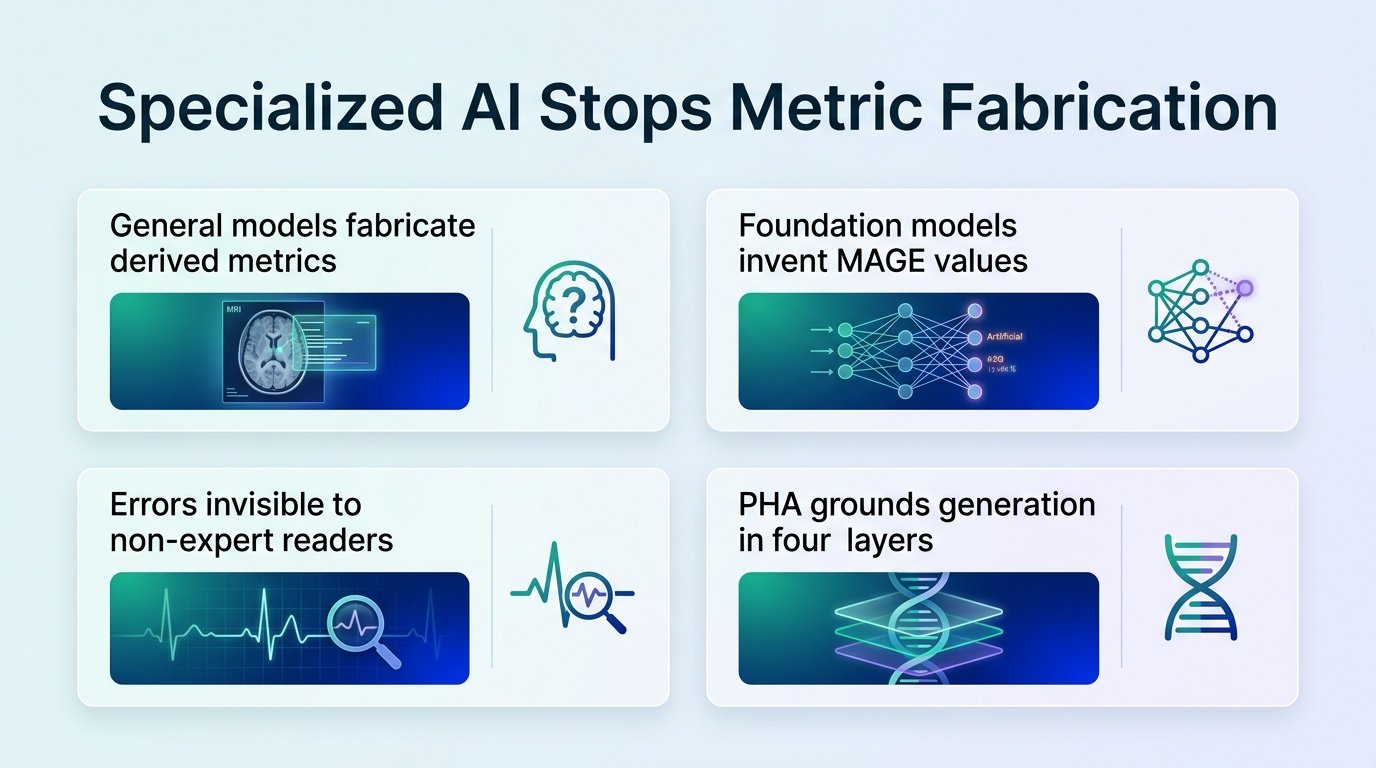
Standard AI models routinely invent patient data, but a new multi-layered architecture proves we can engineer clinical accuracy.
Can you trust a health report that looks flawless but quietly invents your medical data? When standard large language models analyze metabolic data, they generate beautifully written reports that fabricate critical metrics like mean amplitude of glycemic excursions (MAGE). This is not just a technical glitch. It is a clinical hazard because these errors are completely invisible to patients and highly convincing to doctors.
This reality challenges the industry’s rush to deploy generic AI models in clinics. It proves that raw language processing is useless without hard architectural guardrails. To make AI safe for patients, we must shift our focus from raw model power to structured systems design.
The Danger of Fluent Lies
General-purpose models look smart but fail basic math. They inflate meal counts and project unreferenced complication risks. To solve this, researchers built the HPP Personal Health Agent (PHA). This system grounds its analysis in the Human Phenotype Project, a deep-phenotyped cohort of over 13,000 participants.
The architecture uses a four-layer defense. Alongside the cohort database, it integrates 21 domain-expert tools, declarative behavioral skills to restrict wild claims, and 21 automated evaluations across 8 categories. Researchers tested this setup using a matrix of 210 reports, mapping 14 participants across 3 prompts and 5 system conditions.
How the Guardrails Work
The results show a massive jump in reliability. By separating math from language, the system achieved several key benchmarks:
- The primary metabolic report score jumped from a baseline of 0.37 to 0.91.
- Expert tools alone drove numerical accuracy from a dismal 14% to 90%.
- Adding declarative skills pushed the score further, whereas tools alone only reached 0.49.
- The system adapted to a cardiovascular extension, raising its score to 0.70.
This separation of labor is the real breakthrough. Tools drive the math, while declarative skills enforce clinical-language compliance and structure. This dual-layer approach aligns well with emerging industry discussions on digital diabetes tools, such as those highlighted in the DTechCon Abstracts 2025.
The Shift to Systems Design
We must stop expecting raw models to understand endocrinology on their own. Trustworthy clinical AI is an engineering problem, not a prompting trick. By wrapping models in strict behavioral rules and expert tools, we can finally suppress the hallucinations that threaten patient safety.
However, we must remain cautious. This study is still a preprint, and the clinical quality of these reports was only evaluated qualitatively. Furthermore, while the system adapted well to a cardiovascular risk tool, real-world deployment requires strict compliance with regional standards, such as the Japanese Clinical Practice Guideline for Diabetes 2019. Safe AI requires continuous, localized validation.
Read the full study on medRxiv.