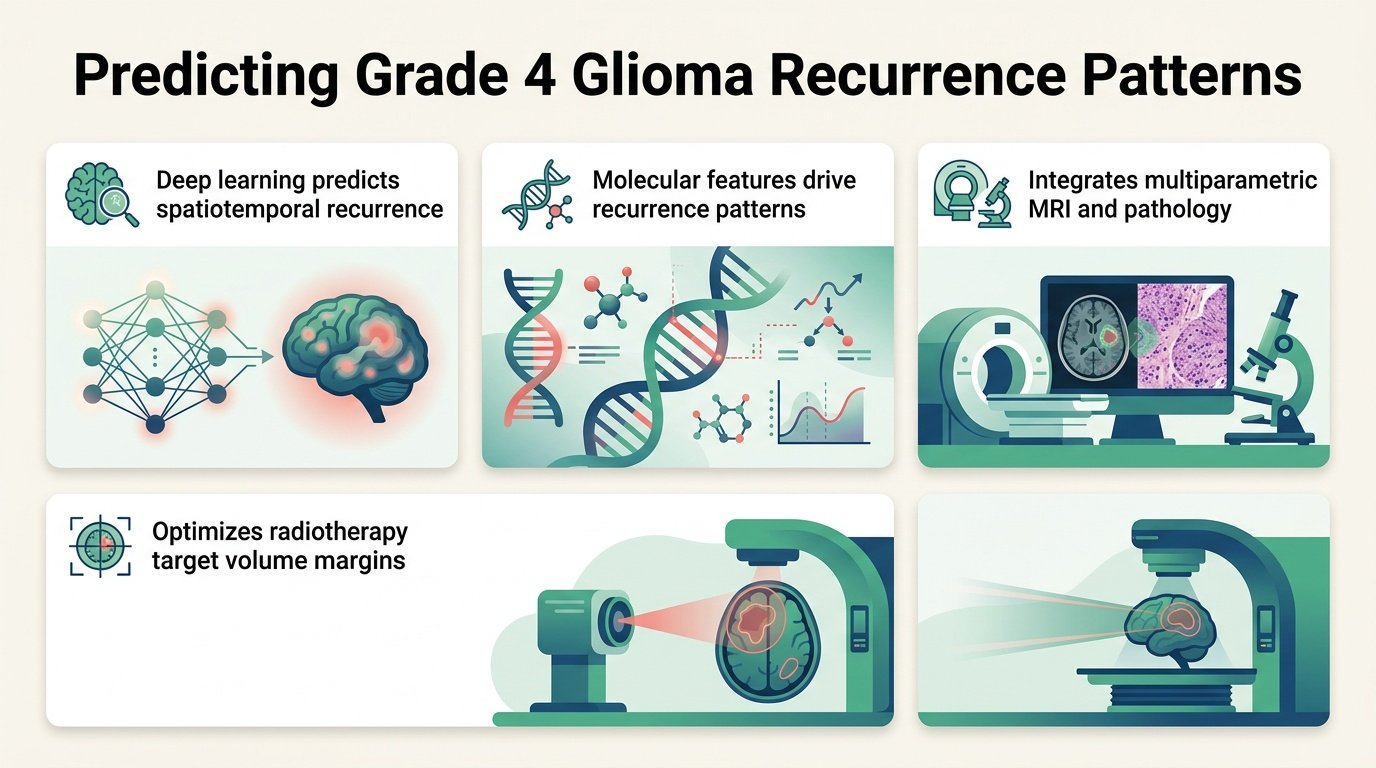
Title: AI predicts brain tumor recurrence patterns
Standard radiation therapy treats every brain tumor margin the same way, but deep learning reveals that tumor geometry and location dictate how cancer spreads.
Why do oncologists treat highly variable brain tumors with uniform radiation margins? For decades, standard guidelines have mandated identical margins for grade 4 gliomas. This blunt approach ignores how a tumor’s specific shape and molecular makeup dictate its return.
A new study challenges this status quo. By using deep learning to analyze 390 paired MRI scans from Norwegian clinics and the Cancer Imaging Archive collected between 2015 and 2025, researchers proved that tumor geometry at diagnosis predicts survival. This shifts the conversation from simply measuring tumor size to analyzing its internal composition. It suggests that uniform radiation margins are an outdated compromise.
The power of tumor ratios
The research team used machine learning to segment tumors into contrast-enhancing (CEcore) and non-enhancing (NE) regions. They discovered that the ratio between these two zones is a powerful predictor of patient outcomes.
- Patients with a CEcore/NE volume ratio of 0.324 or less had a significantly lower risk of death (adjusted HR = 0.56, 95% CI 0.37–0.84, p = 0.006).
- Among patients with the aggressive IDH-wildtype, MGMT-unmethylated subtype, this low ratio extended median survival by 4.3 months (median 17.6 vs 13.3 months, p = 0.0209).
- Tumors starting in the occipital lobe showed a 57.1% chance of migrating to new sites, with the shortest time to progression (adjusted HR = 1.90, p = 0.026).
- Longer time to progression correlated with larger HD95 migration distances (p < 0.03).
Rethinking radiation margins
This finding matters because it provides a concrete path to personalize radiation fields. If an occipital tumor has a 57.1% chance of migrating far from its origin, treating it with the same margin as a frontal lobe tumor is a clinical mistake. Clinicians can now use these spatial-temporal patterns to spare healthy brain tissue while intensifying radiation where the cancer is highly likely to travel.
However, the study has limitations. The data relies on retrospective scans, and translating these deep learning segmentations into daily clinical workflows is difficult. Prospective trials are still required to prove that changing radiation margins based on these algorithms actually extends lives without increasing radiation toxicity.
Read the full study in npj Precision Oncology.