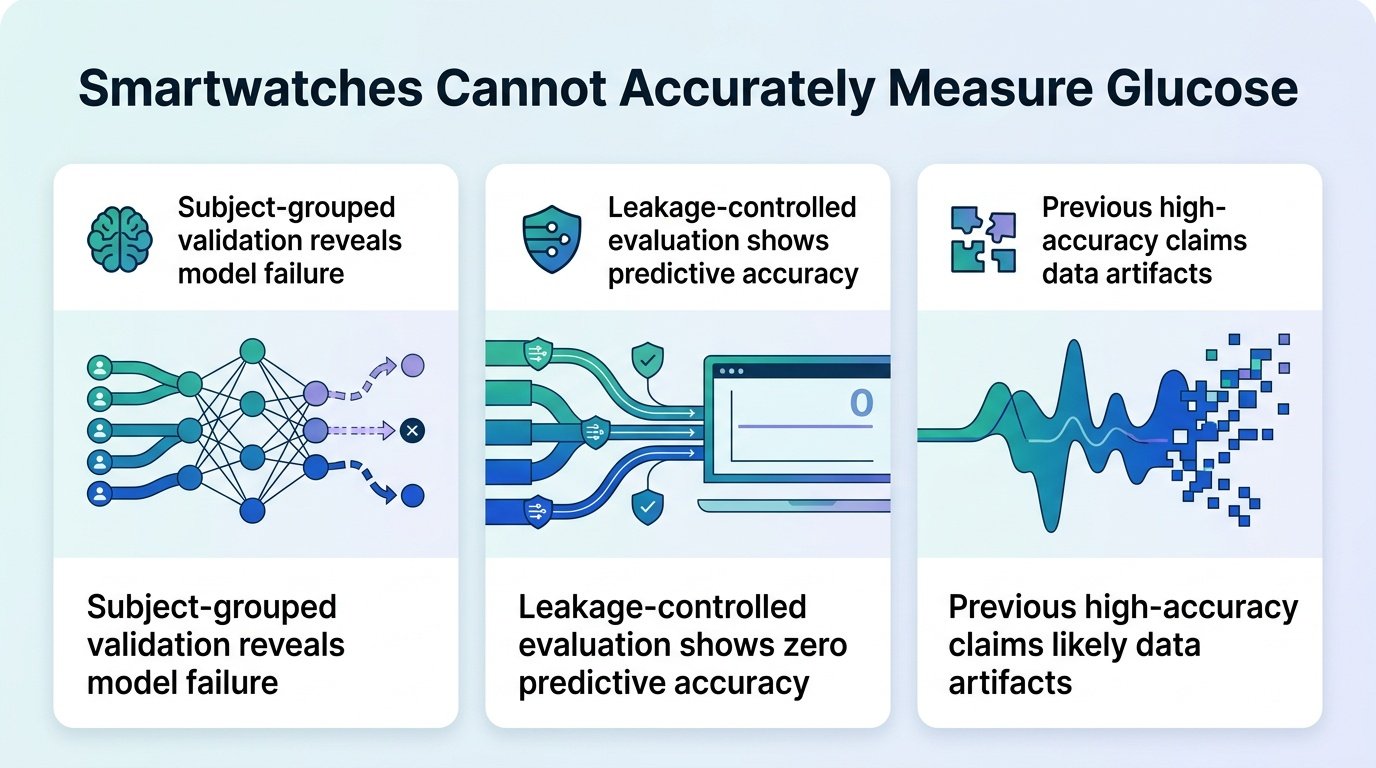
A rigorous new evaluation reveals that wrist-worn wearables capture no real blood glucose data, exposing a major flaw in non-invasive tracking claims.
Can a smartwatch replace a needle? For years, consumer tech companies have hinted at non-invasive glucose tracking. They point to studies showing high accuracy from wrist-worn sensors. But a new analysis suggests these successes are an illusion. When researchers eliminated data leakage, the sophisticated algorithms collapsed. They performed no better than a simple guess.
This finding challenges the entire narrative of wrist-based metabolic tracking. The problem is not the math. It is the physics. No amount of advanced machine learning can extract signal from noise if the physical sensor never captures the biological data in the first place.
The data leakage trap
To test the technology, researchers analyzed data from the BIG IDEAs Lab Glycemic Variability and Wearable Device dataset. They studied 15 participants wearing both a Dexcom G6 continuous glucose monitor and an Empatica E4 wristband. Crucially, they used subject-grouped cross-validation. This setup ensured that no participant’s data appeared in both the training and testing sets.
Without this strict barrier, models cheat. They memorize individual baselines rather than learning true physiological relationships. When researchers blocked this leakage, the algorithms failed to deliver on their promises.
The study evaluated three distinct model families, including gradient-boosted trees, a fully convolutional network, and a temporal convolutional network. All of them hit the exact same performance wall. This convergence indicates a hard information ceiling, not a modeling limitation.
No signal to extract
The performance metrics reveal a stark reality for multi-sensor wearables:
- Forecasting glucose 30 minutes ahead using CGM history hit a hard ceiling at an RMSE of 13.90 +/- 0.58 mg/dL, where basic linear regression matched complex neural networks.
- Adding wrist-worn PPG, skin temperature, electrodermal activity, and motion data failed to improve forecasting, with error rates shifting insignificantly from 13.56 to 13.60 mg/dL.
- Wristband-only estimation scored 22.58 mg/dL, which was statistically identical to predicting the time of day at 22.63 mg/dL or simply guessing the cohort average of 22.76 mg/dL.
In this normoglycemic cohort, wrist signals carried zero glucose information. The complex sensor fusion architectures did not fail because of poor design. They failed because the sensors themselves do not acquire the necessary biological data. Sensor fusion cannot recover information that was never captured.
This suggests that current consumer wristwear cannot track glucose. Companies selling these features may be selling glorified clocks that guess your blood sugar based on the time of day.
We must note the study’s limits. The dataset was small, with only 15 participants, and they were all healthy individuals with normal blood sugar levels. It remains possible that extreme glucose swings in diabetic patients might register on wrist sensors. However, for the general public, the tech is blind.
Read the full preprint in medRxiv.