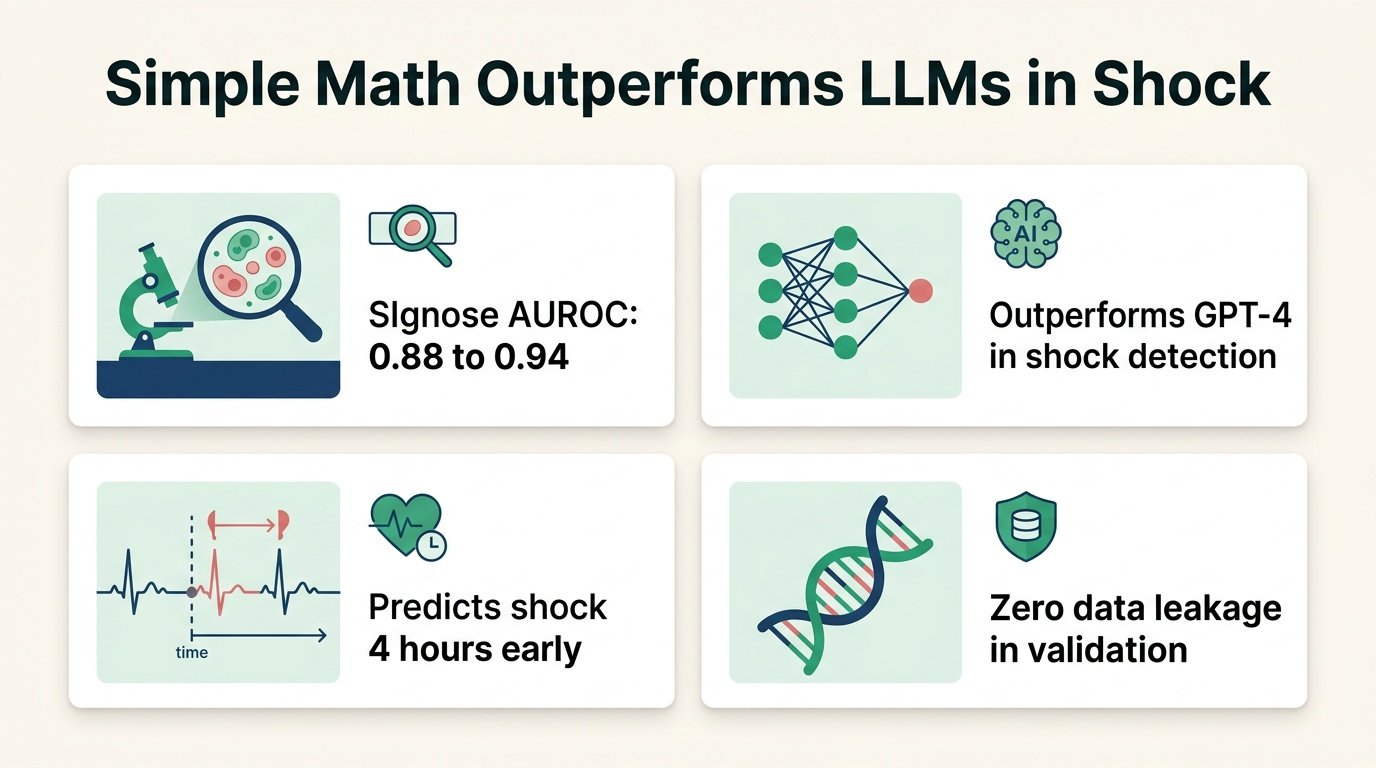
A new study reveals that basic physiological math outpaces complex large language models at predicting patient crash times.
Why are we throwing massive, power-hungry artificial intelligence at clinical data when simpler math does a better job? The rush to force large language models into every corner of medicine has hit a wall in the intensive care unit.
A new preprint introduces SIgnose, a model designed to predict hemodynamic deterioration up to eight hours before clinical recognition. Instead of relying on massive neural networks, the researchers focused on traditional physiological variability. This challenges the current tech gold rush. It proves that for time-sensitive ICU signals, structured biological knowledge beats brute-force deep learning.
This finding matters because it directly refutes the idea that we need generative AI to solve clinical prediction. It means hospitals can run advanced early-warning systems on cheap, existing bedside hardware. They do not need to send sensitive patient data to the cloud or purchase expensive computing clusters.
How the model works
The researchers built SIgnose using 3,970 features derived from just five routinely monitored vital signs. They benchmarked three representation strategies. These included engineered physiological variability, deep learning, and Llama-3.1-8B embeddings with low-rank adaptation. The simplest approach won.
By focusing on heart rate variability and respiratory trends, the model avoided the noise that often derails deep learning in messy, real-world environments. This builds on previous efforts to find stable clinical indicators, such as using heart rates to predict tachycardia and instability. It suggests that the future of bedside monitoring lies in refining raw signals, not building larger neural nets.
The performance numbers
SIgnose proved remarkably stable across different hospitals and age groups. It did not just perform well on its training data; it held up under external testing. The model achieved high accuracy across several distinct cohorts:
- On the eICU development database, it achieved an AUROC of 0.861 (95% CI 0.859-0.863) and an AUPRC of 0.927 (95% CI 0.925-0.929).
- On the MIMIC-III adult database, external validation yielded an AUROC of 0.870 (95% CI 0.863-0.876) and an AUPRC of 0.935 (95% CI 0.930-0.940).
- On the SafeICU pediatric database, it reached an AUROC of 0.875 (95% CI 0.863-0.888) and an AUPRC of 0.915 (95% CI 0.898-0.930).
- In a prospective pediatric trial of 88 patients, it maintained an AUROC of 0.885 (95% CI 0.868-0.902) and an AUPRC of 0.911 (95% CI 0.882-0.936).
That consistency is the real story.
Most predictive models degrade when moved to a new hospital. SIgnose actually performed better on external cohorts than on its development set, proving its underlying math is clinically sound.
The limits of complexity
This success highlights a critical lesson for clinical AI. While some researchers still argue there is a long wait for practical AI in acute care, SIgnose shows that the barrier might be our obsession with over-engineering. We do not need massive computing clusters at the bedside to save lives.
However, we must remain cautious. The prospective validation cohort was small, containing only 88 pediatric patients. We need larger, multi-site prospective trials before claiming this can safely run on every bedside monitor. Until then, it remains a highly promising proof of concept.
Read the full preprint on medRxiv.