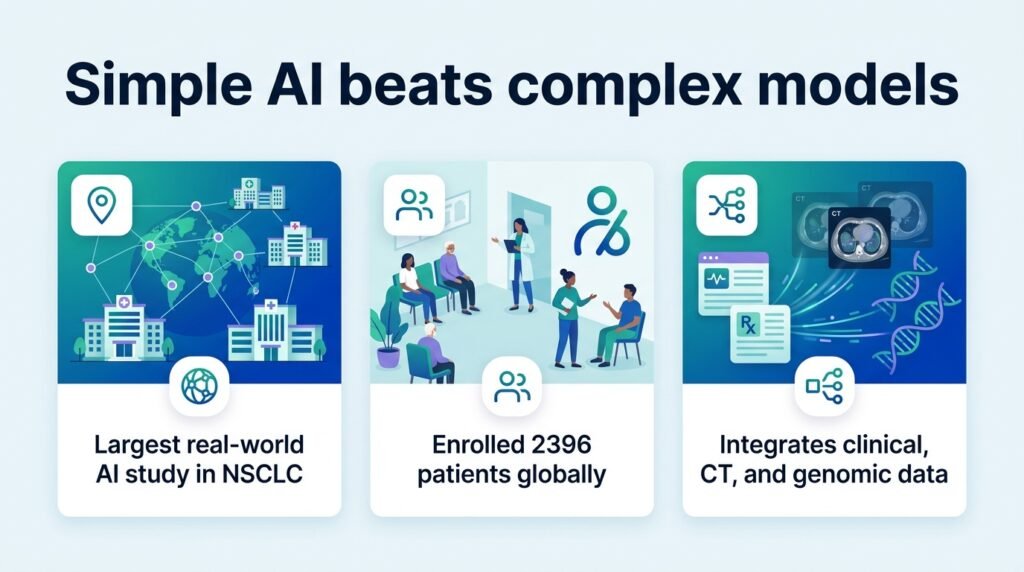
A massive lung cancer study reveals that simple clinical data paired with explainable AI outperforms complex multimodal models in real-world validation.
Why do we keep building complex AI systems when simpler data works better? For a decade, selecting immunotherapy for non-small cell lung cancer (NSCLC) has relied on imperfect biomarkers. This leaves clinicians guessing which patients will actually benefit from aggressive treatment.
The I3LUNG study challenges the industry obsession with “multimodal” AI. Tech developers love combining CT scans, digital pathology, and genomics. However, this trial shows that adding more data layers does not automatically yield better real-world predictions.
Key trial outcomes
The I3LUNG trial enrolled 2,396 patients, making it the largest international, real-world, AI-based study of its kind. Researchers built machine learning early fusion (MLEF) and deep learning intermediate fusion (DLIF) models. The results expose a sharp divide between training hype and clinical reality:
- Clinical and blood-only models achieved an AUC of up to 0.77 in the test set.
- External validation performance dropped to an AUC range of 0.55 to 0.72 due to population differences.
- The AI outperformed standard biomarkers, including PD-L1, ECOG PS, NLR, LDH, and the LIPI score.
- Multimodal integration of clinical, imaging, and pathology data failed to show clear incremental benefits in external testing.
Simpler data wins
The failure of multimodal integration to deliver real-world benefits is a wake-up call. While combining clinical, CT, and pathology data showed promise in early stages, this benefit did not translate to the independent test or external validation sets. Piling on expensive imaging and pathology data may not be worth the cost or clinical effort.
This pragmatic approach aligns with broader discussions on how AI-based diagnosis integrates into clinical practice, as explored in advances in clinical AI. The real victory lies in clinical usability. Both lung cancer experts and nonexpert physicians improved their treatment predictions when using the explainable AI tool based only on clinical and blood data.
This mirrors trends in other oncology fields. For instance, researchers are looking at how AI can analyze blood-based biomarkers to refine therapy, as detailed in liquid biopsy applications. In both cases, the goal is to extract maximum value from easily obtainable patient data.
The road ahead
We must remain cautious about these findings. The drop in external validation scores proves that AI models remain highly sensitive to local patient demographics. AI is not a plug-and-play solution for every hospital system.
To address these limitations, a prospective validation of the decision support system is currently underway in more than 2,000 patients. Until those results are in, clinicians should view multimodal AI as a promising research tool rather than a ready-to-use clinical asset.
Read the full study in Nature Medicine.