A prominent AI skeptic is now betting on autonomous agents to run complex drug discovery physics.
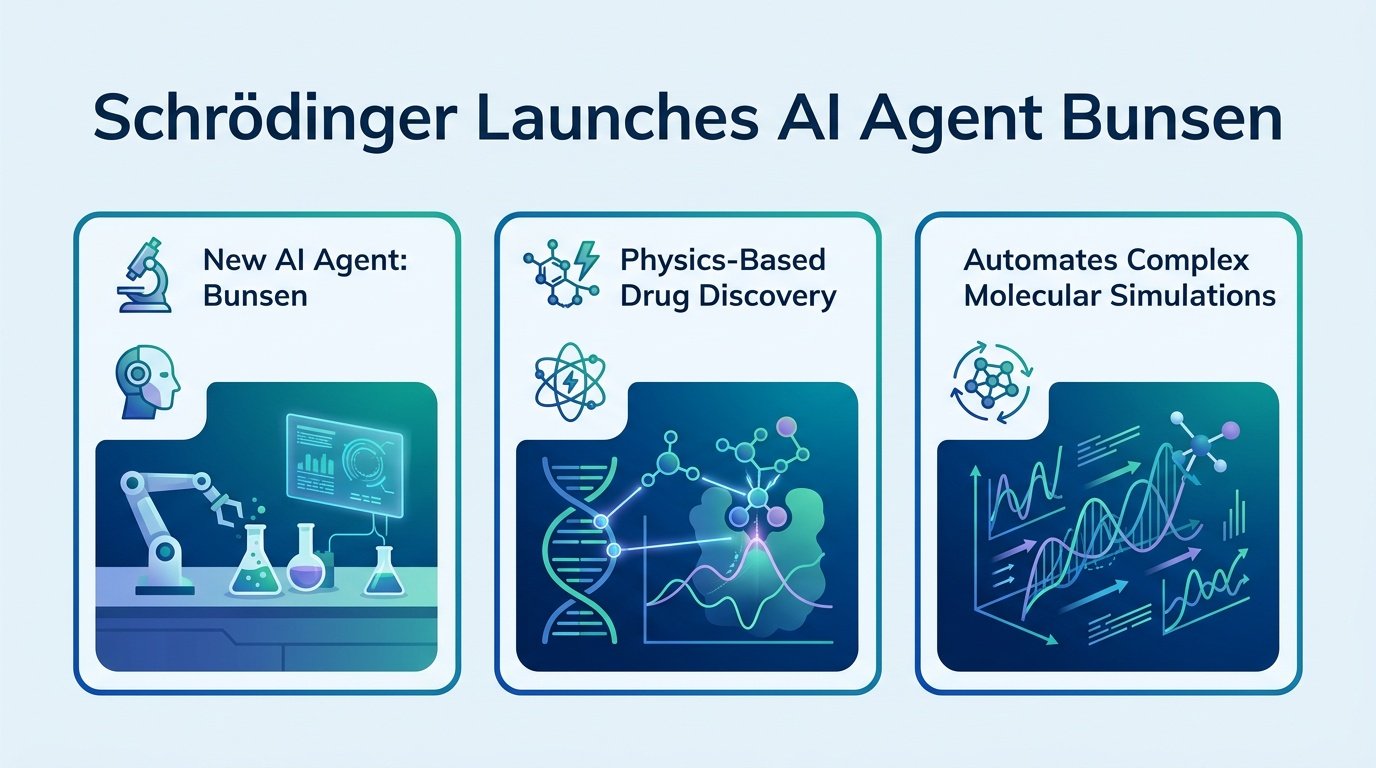
Three years ago, Schrödinger’s leadership warned that AI hype had reached dangerous, insane levels. Today, the company is launching Bunsen, an AI agent designed to operate its proprietary physics software. This is not just another chatbot. It represents a pivot from passive data retrieval to active, autonomous workflow execution.
The Agentic Shift
Bunsen allows researchers without computational expertise to screen billions of chemical compounds using natural language. By securing an immediate deployment deal with Bristol Myers Squibb, Schrödinger is testing whether autonomous agents can reliably scale molecular design. The system runs on infrastructure co-engineered by NVIDIA and Google Cloud.
This move signals a deeper industry trend. Biopharma is moving past simple predictive algorithms. The new goal is agentic AI: systems that can plan, execute, and troubleshoot complex scientific tasks on their own. It lowers the technical barrier, letting laboratory biologists run advanced computational suites.
The Validation Gap
But delegating complex physics simulations to an AI agent introduces new risks. While natural-language interfaces democratize access, they also distance human scientists from the underlying math. If Bunsen misinterprets a prompt or misapplies a physics constraint, errors could propagate silently through early-stage pipelines.
Schrödinger’s pivot proves that even the loudest skeptics cannot ignore the pressure to automate. The real test is whether these autonomous agents can actually find viable clinical candidates. Otherwise, they risk simply generating a higher volume of sophisticated noise.