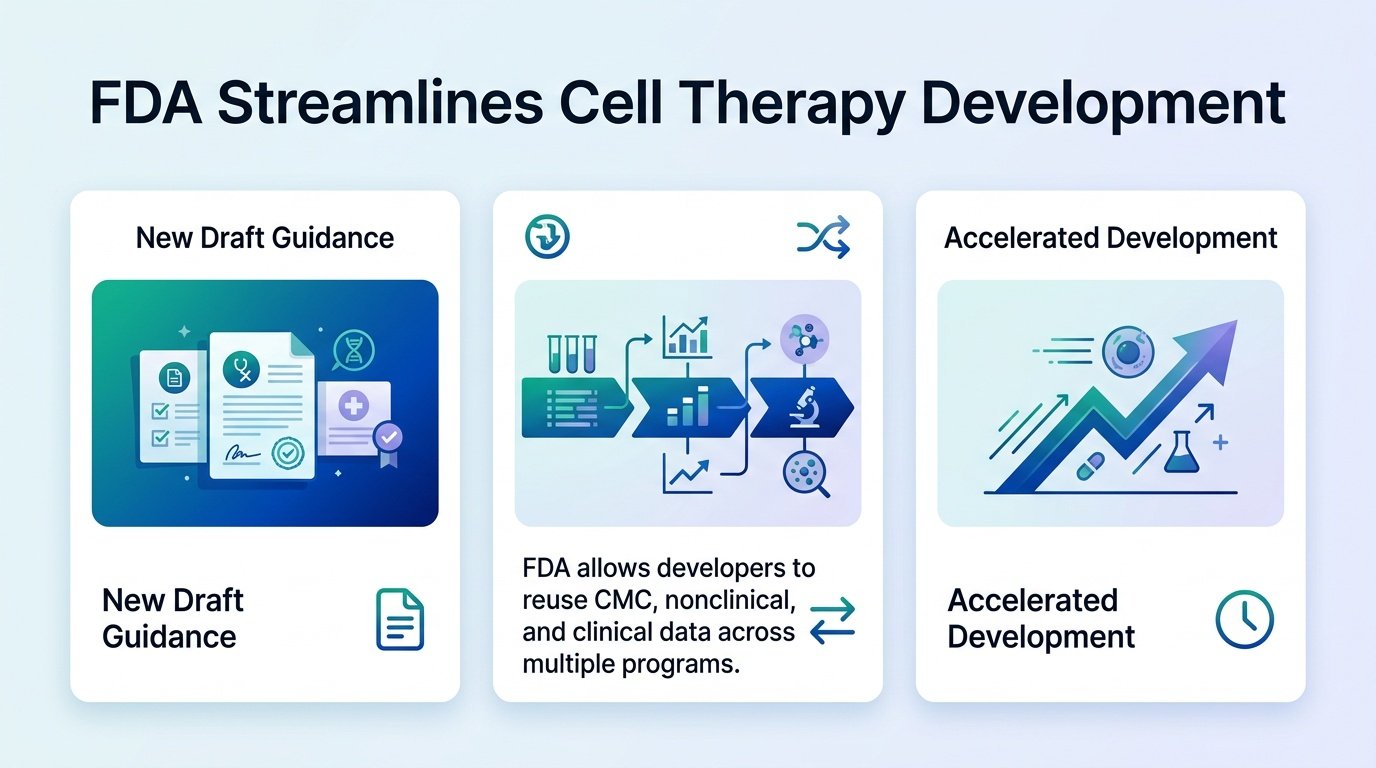
The FDA is letting drugmakers recycle data from past trials to speed up gene therapies, but this regulatory shortcut places a massive burden of proof on developers.
The Data Shortcut
For years, cell and gene therapy developers had to start from scratch for every new candidate. Even if they used the exact same delivery vehicle or manufacturing process, regulators demanded redundant, costly testing.
A new draft guidance changes this. The FDA will now allow companies to reuse chemistry, manufacturing, and clinical data across multiple programs. This is a major shift for rare disease treatments, which often stall because patient populations are too small to support repeated, full-scale trials.
The Catch for Developers
This is not a free pass. The agency is not lowering its safety standards.
Sponsors must still provide robust, product-specific scientific rationales to justify reusing old data. If a developer cannot prove their platform behaves identically across different genetic targets, the shortcut vanishes. The strategy shifts the bottleneck. The challenge is no longer just generating raw data, but proving historical data remains relevant to a new disease target.
The Analytical Take
This move signals a regulatory transition toward platform-based approvals. Regulators are finally acknowledging that the delivery mechanism can be evaluated separately from the genetic payload.
For resource-constrained startups, this could slash development costs and prevent duplicative testing. But it also means early-stage design choices are more critical than ever. A flaw in the initial platform design could now compromise an entire pipeline of future therapies. Companies must invest heavily in characterization technologies early on. If you cannot map your platform’s behavior with extreme precision, this regulatory fast-track remains out of reach.