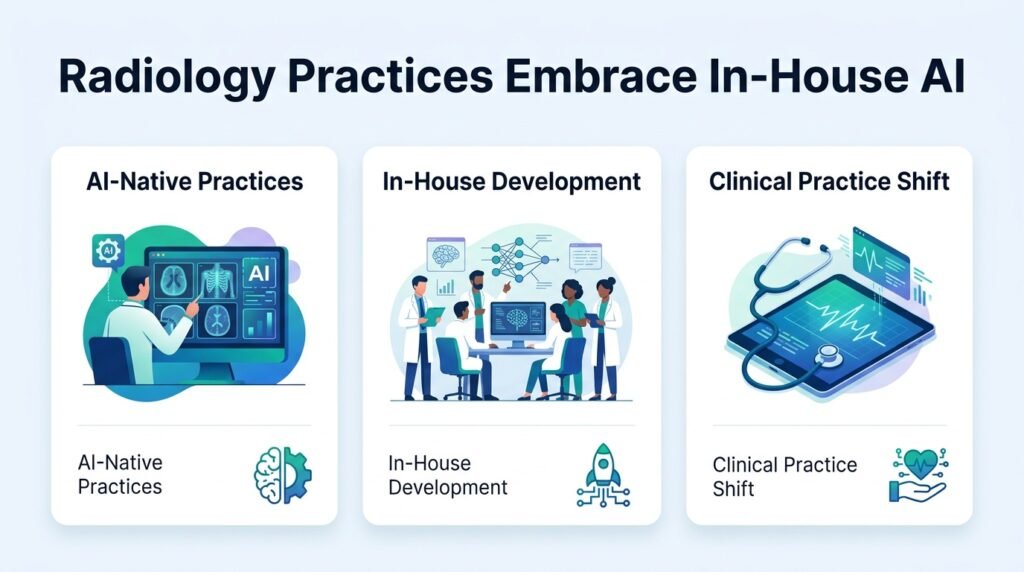
Radiology groups are no longer waiting for software vendors to build clinical AI; they are becoming the software companies themselves.
Severe physician burnout and skyrocketing imaging volumes are forcing a radical shift. Instead of buying third-party tools, some venture-backed startups are acquiring clinical practices to build and deploy AI in-house. They are marketing themselves as “AI-native.”
This is not just a change in purchasing. It is a collapse of the boundary between technology development and clinical practice.
The DIY shift
Radiology already accounts for over 80% of FDA-cleared medical AI. Yet hospital sales cycles are notoriously slow. By building full-stack clinical practices, these startups bypass the traditional procurement bottleneck. They monetize AI-driven workflows directly.
The industry is moving from narrow, task-specific tools toward multimodal foundation models. These models integrate directly with electronic health records. But this DIY approach comes with serious risks.
The clinical reality
While AI-driven triage improves operational efficiency, the downstream benefits to actual patient outcomes remain inconsistent.
Integrating these tools seamlessly into daily clinical workflows is still a major hurdle. There is also the silent threat of automation bias. When radiologists rely too heavily on in-house algorithms, subtle diagnostic errors can slip through.
Medical software has historically faced rigorous external vetting. When the developer and the practitioner are the same entity, traditional guardrails disappear.
This shift forces a critical question: are we optimizing for patient health, or just speed?