

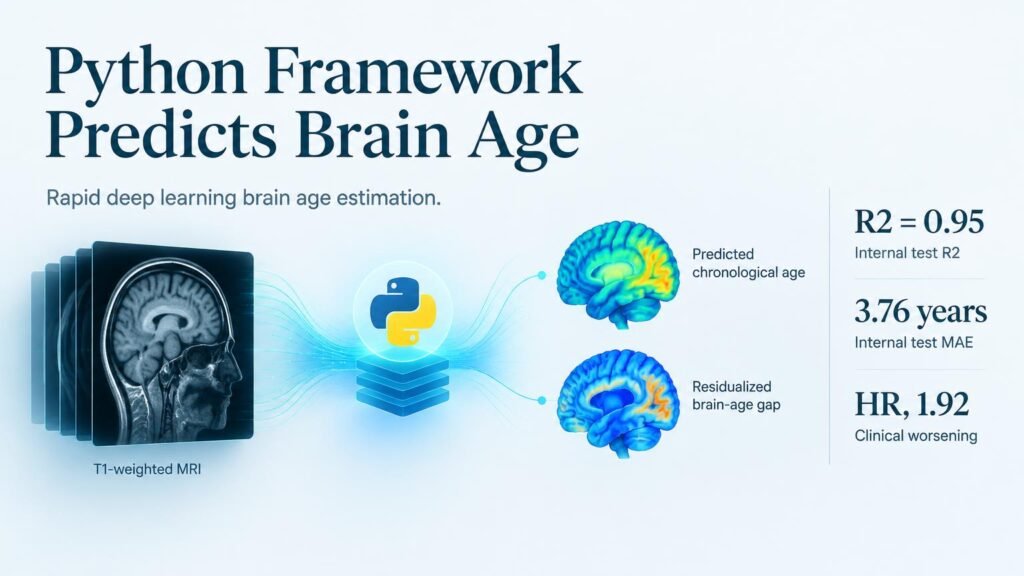
A open-source brain age estimation pipeline predicts cognitive decline by measuring structural brain aging rather than amyloid pathology.
Brain age models often rely on complex preprocessing software that stalls real-world deployment. Researchers simplified this pipeline using freely available Python tools, creating a model that tracks structural changes linked to clinical worsening. The underlying signal tracks vascular damage rather than classic Alzheimer’s plaques.
That distinction changes how clinicians should interpret biological brain age gaps.
Open-Source Model Matches Benchmarks
The study trained a deep learning model on 4,346 cognitively normal adults with a mean age of 47.0 ± 21.2 years, including 2,414 women. Performance remained steady across two external test sets of 315 and 209 patients, demonstrating strong generalizability. These results align with broader efforts to improve model portability across varied clinical datasets, as explored in prior foundation model research for brain age estimation.
- Internal test performance reached an R² of 0.95 with a mean absolute error (MAE) of 3.76 years.
- External validation cohorts maintained an R² between 0.69 and 0.90 with an MAE ranging from 4.82 to 5.15 years.
- Testing in the clinical BICWALZS cohort (n = 954) confirmed the residualized brain-age gap (BAG) increased significantly across diagnostic groups (P < .001).
- Elevated BAG predicted an increased risk of longitudinal clinical worsening with a hazard ratio of 1.92.
Vascular Risks Drive the Gap
The biological driver behind the brain-age gap was not amyloid deposition. The gap correlated strongly with white matter hyperintensity severity (odds ratio 1.64, P < .001) and stroke history (odds ratio 1.46, P < .001). However, the association with amyloid PET positivity disappeared after full covariate adjustment (P = .17).
This finding reinforces that neuroimaging AI models must be evaluated against specific biological mechanisms rather than generic dementia markers. Previous studies on multi-channel attention networks across the lifespan similarly point to complex structural changes driving age predictions.
The pipeline relies on retrospective data, meaning real-time workflow performance remains unproven. Still, the practical takeaway is clear: an elevated brain age gap points strongly toward cerebrovascular burden and future cognitive decline, but it cannot serve as a proxy for amyloid pathology.
Read the full paper in Radiology: Artificial Intelligence.