
Big Pharma is no longer just buying software; it is panic-buying entire tech ecosystems to avoid falling behind.
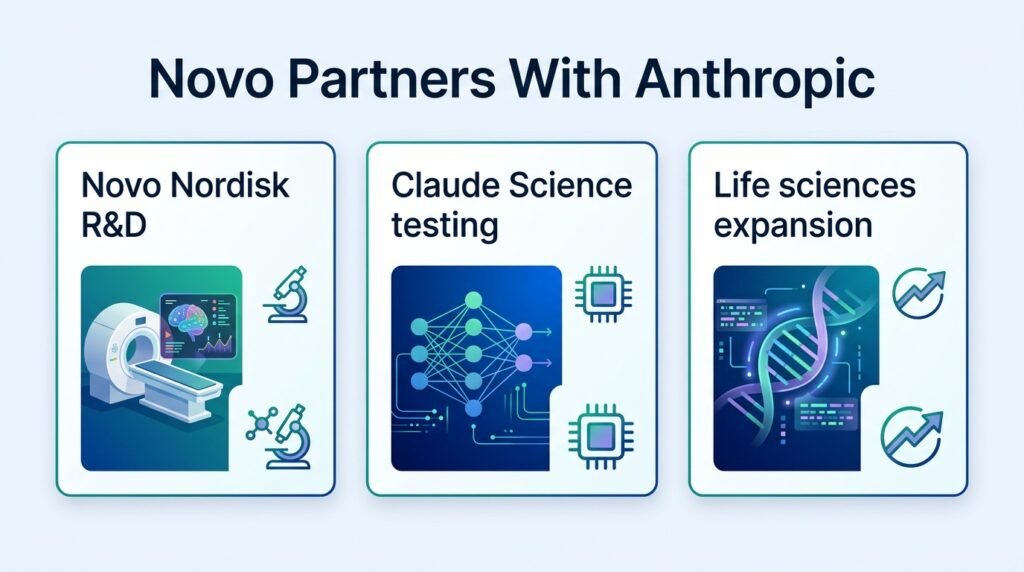
Novo Nordisk just signed its third major AI partnership of 2026. By partnering with Anthropic to test its Claude Science workbench, the Danish drugmaker is racing to build an impenetrable digital moat. This follows high-profile deals with OpenAI in April and Amazon Web Services in August.
The sheer speed of these deals signals a shift in how drug companies view survival.
The AI arms race
Novo is not alone in this sprint. Competitors like Eli Lilly, Bristol Myers Squibb, and Roche are aggressively locking down exclusive or early-access deals with tech giants. The goal is simple: compress decades of traditional laboratory research into years.
But this sudden rush reveals a deeper anxiety.
Drug discovery bottlenecks are worsening, and the patent clock is always ticking. By hoarding partnerships with Anthropic and Nvidia, these companies hope to monopolize the best computational pipelines before their rivals do. It is an expensive game of musical chairs.
The limits of code
Yet, throwing algorithms at biology has its limits. An AI model can predict molecular structures, but it cannot bypass human clinical trials. The regulatory hurdles and biological realities remain unchanged.
Claude Science must prove it can do more than just generate plausible hypotheses. It has to deliver molecules that survive the brutal reality of human testing.
If these expensive platforms fail to deliver actual, approvable drugs, this massive capital expenditure will look less like strategic foresight and more like expensive panic-buying.