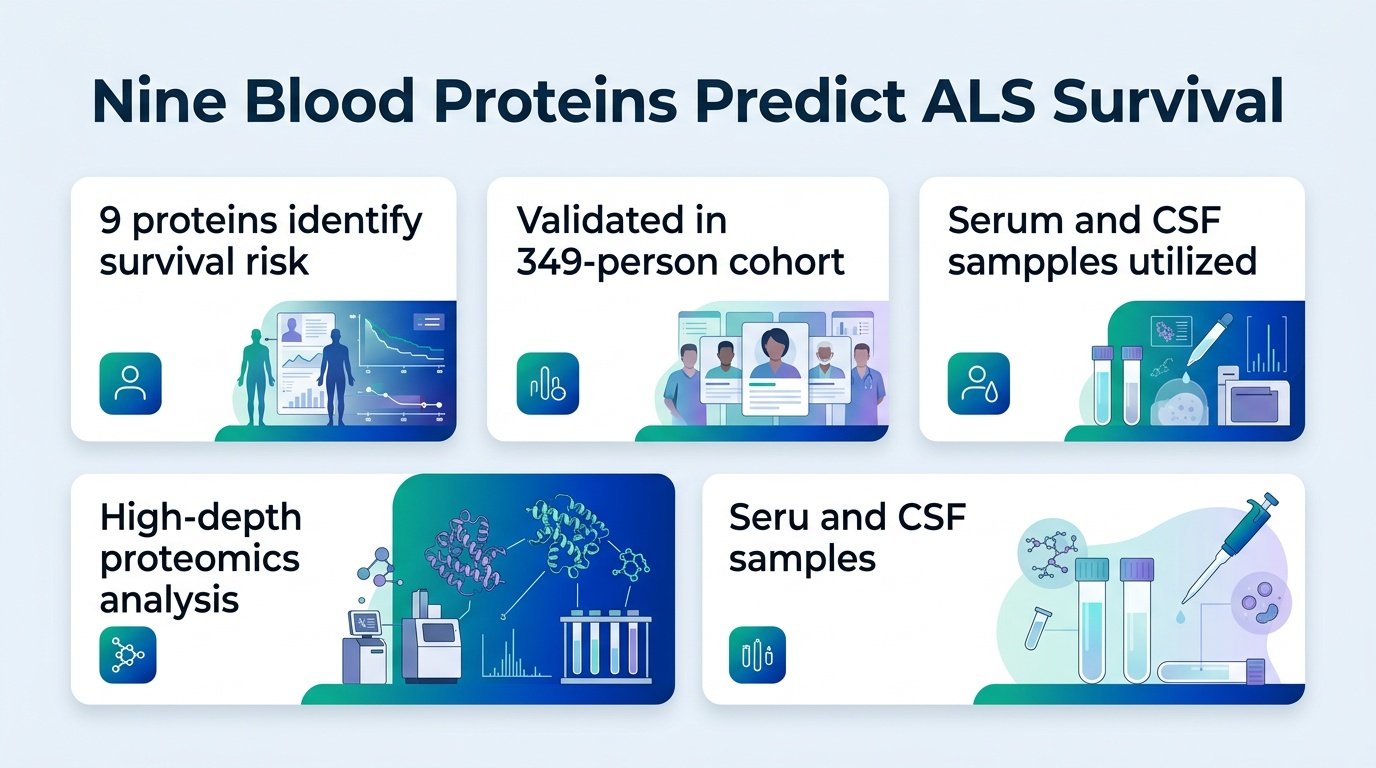
A new nine-protein blood signature outperforms traditional clinical models and single-marker tests in predicting how fast ALS progresses.
For years, clinical trials for amyotrophic lateral sclerosis (ALS) have stalled because we cannot predict how fast a patient will decline. One patient survives a decade, while another loses motor function in months. This unpredictability ruins clinical trials, as researchers cannot tell if an experimental drug is working or if they simply enrolled slow-progressing patients.
Doctors have leaned heavily on neurofilament light chain (NEFL) as the gold-standard biomarker. But a single structural protein cannot capture the entire systemic storm of ALS. This new research challenges the single-biomarker obsession by proving that a multi-pathway signature is far more accurate.
The researchers analyzed **1,095** biofluid samples, which included **851** serum samples and **244** cerebrospinal fluid (CSF) samples. These samples came from **426** individuals living with ALS. To make sure the biological signals held up, the team validated their results in an external replication cohort of **349** people with ALS.
Beyond a single biomarker
The statistical analysis revealed a much broader biological signature than previously tracked. The researchers identified several key protein relationships:
- They found **57** proteins in serum and **5** proteins in CSF associated with survival.
- A refined panel of **9** serum proteins, including NEFL, peripherin, EDA2R, and calcitonin, improved survival predictions compared to models using clinical parameters and NEFL alone.
- Longitudinal tracking showed that the trajectories of EDA2R and calcitonin directly correlate with survival.
The inclusion of proteins like EDA2R and calcitonin is highly telling. These markers point to systemic inflammation and metabolic changes, not just dying neurons. This suggests that predicting ALS progression requires looking at how the whole body reacts to the disease, rather than just measuring structural nerve damage.
The trial design bottleneck
This shift in thinking is where the real value lies. If clinical trials can group patients by their biological trajectory rather than just their current physical symptoms, we can design shorter, cheaper, and more successful trials. It changes how we define disease progression from a purely neurological event to a systemic one.
There are clear hurdles. Measuring a nine-protein panel longitudinally is more expensive and logistically complex than running a single NEFL test. This is also a preprint, meaning the findings still require peer review and standardized, commercial-grade assays before clinical adoption.
But the trade-off is worth it. Moving beyond NEFL to a multi-protein signature could stop drug developers from abandoning promising therapies that fail in heterogeneous trial groups but work in specific biological subtypes.
Read the full preprint on medRxiv.