

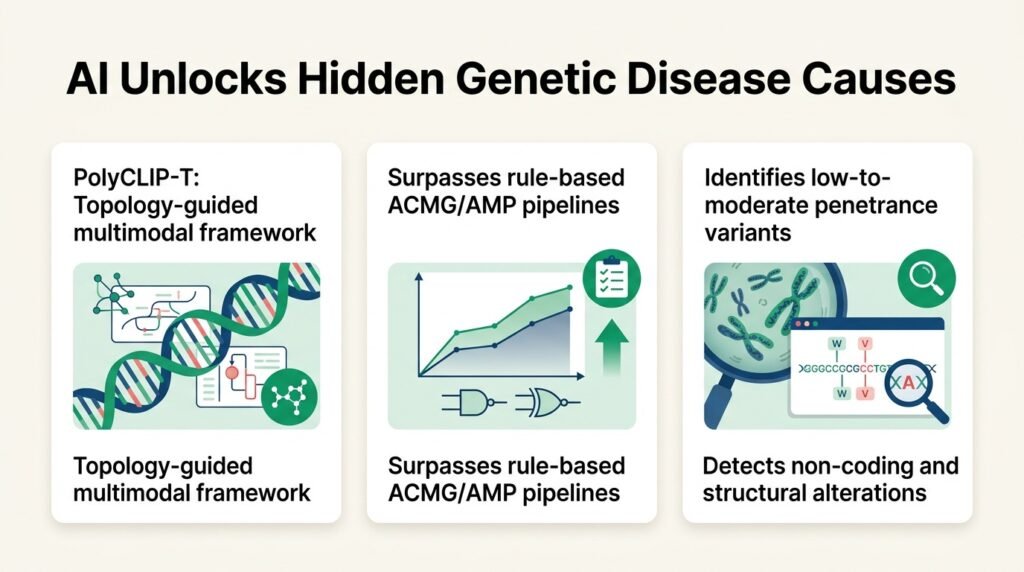
Standard genetic tests miss the complex networks of DNA variants that cause multiple diseases in the same family, but a new topological AI approach could change how we find them.
Why do some families suffer from a devastating mix of cancer, heart disease, and autoimmune disorders all at once? Standard genetic pipelines usually look for a single, highly destructive mutation to explain a patient’s symptoms. If they do not find one, the search stops, leaving families without answers and clinicians without a clear path forward.
This binary approach is failing patients with complex, multi-morbid conditions. By treating genetics as a search for a single broken switch, we miss the larger, subtle network of variants working in concert. A new preprint introduces an AI tool called PolyCLIP-T that abandons this single-variant logic entirely, shifting the focus to geometric patterns in our DNA.
Mapping the genetic shape
Instead of classifying variants one by one, the tool uses a math concept called persistent homology to map the “shape” of a family’s genome. It aligns DNA sequences with functional data to measure how much a variant perturbs the molecular system. This allows researchers to identify stable, cooperative groups of variants shared among sick relatives, rather than hunting for an elusive single mutation.
Most clinical pipelines ignore the 98% of our genome that does not code for proteins. PolyCLIP-T specifically targets these non-coding regions, treating the genome as a continuous landscape rather than a list of isolated genes. By contrastively aligning DNA-sequence embeddings, the system quantifies the exact molecular perturbation induced by each variant.
The researchers tested PolyCLIP-T on six families affected by transgenerational multimorbidity, including cancer, autoimmune, and cardiovascular diseases. The AI successfully flagged non-coding and structural DNA variants that traditional rule-based pipelines completely overlooked. These conventional pipelines, anchored in standard ACMG/AMP criteria, are built for simple hereditary diseases but struggle with complex, polygenic architectures.
This disconnect is the real story. For decades, genetics has chased clean, highly penetrant mutations to prove a disease link. This study suggests the active ingredient in family multi-morbidity may be a distributed network of low-penetrance variants, which changes how we must design future diagnostic tools.
What the data shows
The preliminary findings suggest that multi-morbidity is not always a series of unfortunate, unrelated genetic events. Instead, it may stem from shared, pleiotropic networks that span across different disease categories.
- Identified stable polygenic variant clusters across six multi-morbid families.
- Recovered overlooked non-coding and structural candidates missed by standard ACMG/AMP pipelines.
- Mapped pleiotropic networks linking cancer, autoimmune, and cardiovascular diseases.
The clinical reality check
This shift from single-variant scoring to geometric discovery is highly promising, but it faces a steep climb to clinical utility. The framework was developed and benchmarked on a very small cohort of just six deeply characterized families. We cannot yet know if these topological patterns are universal or just unique quirks of these specific families.
Validation in larger, independent populations is essential before this math-heavy approach can influence actual patient care. Clinicians should view this as a powerful research engine rather than an immediate diagnostic solution. For those interested in exploring the framework, the researchers have made an interactive web tool available at polyclip-t.uma.es.
Read the full preprint study on medRxiv.