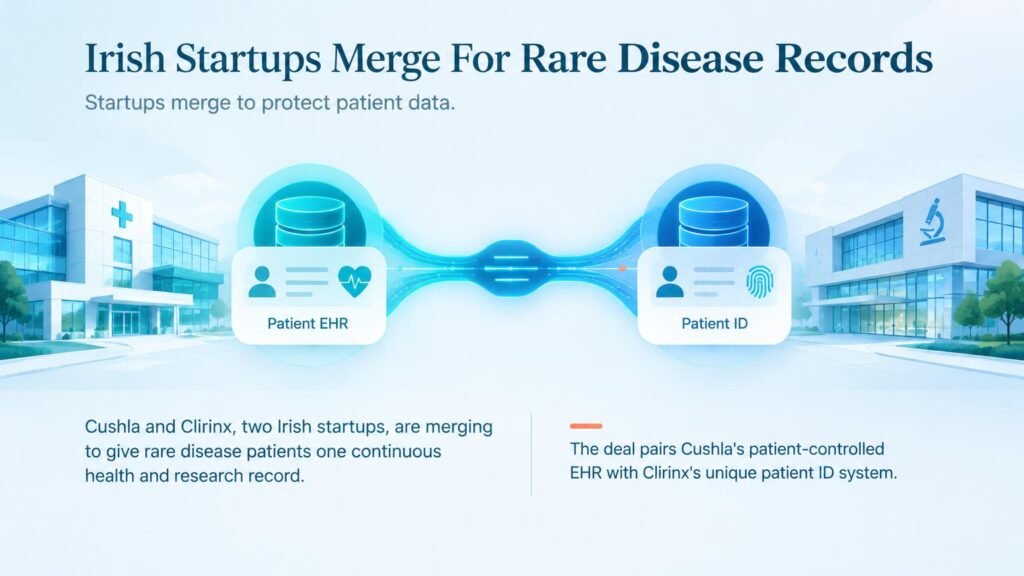
Rare disease patients regularly lose critical health records as they move between clinical trials and specialty providers.
Medical care for complex, rare conditions breaks down when patient data stays trapped inside isolated hospital networks. Every transition between a primary specialist, a remote trial site, and an observational study risks permanently severing a patient’s historical records.
Unifying Longitudinal Records
Irish health-tech startups Cushla and Clirinx are merging to create a continuous, lifelong health and research profile. By integrating Cushla’s patient-controlled health record software with Clirinx’s unique patient identifier platform, the combined system aims to bind dispersed medical histories together.
Data fragmentation actively slows clinical progress. Clirinx’s Clinical Research ID system has issued over 10,000 global identifiers, supporting initiatives like the Parents Speak study for developmental and epileptic encephalopathies. Linking these universal identifiers directly to patient-managed EHRs ensures that longitudinal observational findings, lab results, and trial outcomes remain tied to the individual regardless of geographic or institutional boundaries.
Validation Risks Remain
Consolidating real-world evidence into a single stream reduces administrative duplication for families and clinical research coordinators. Yet patient-managed platforms face persistent operational hurdles.
Success depends on widespread adoption across clinical sites and seamless integration with legacy hospital IT infrastructure. A unified ID system simplifies tracking, but it cannot automatically force risk-averse institutions to sync data or standardize unstructured clinical notes.
Health systems and trial sponsors must now test whether patient-led data portability can reliably replace institutional data silos without adding regulatory overhead.