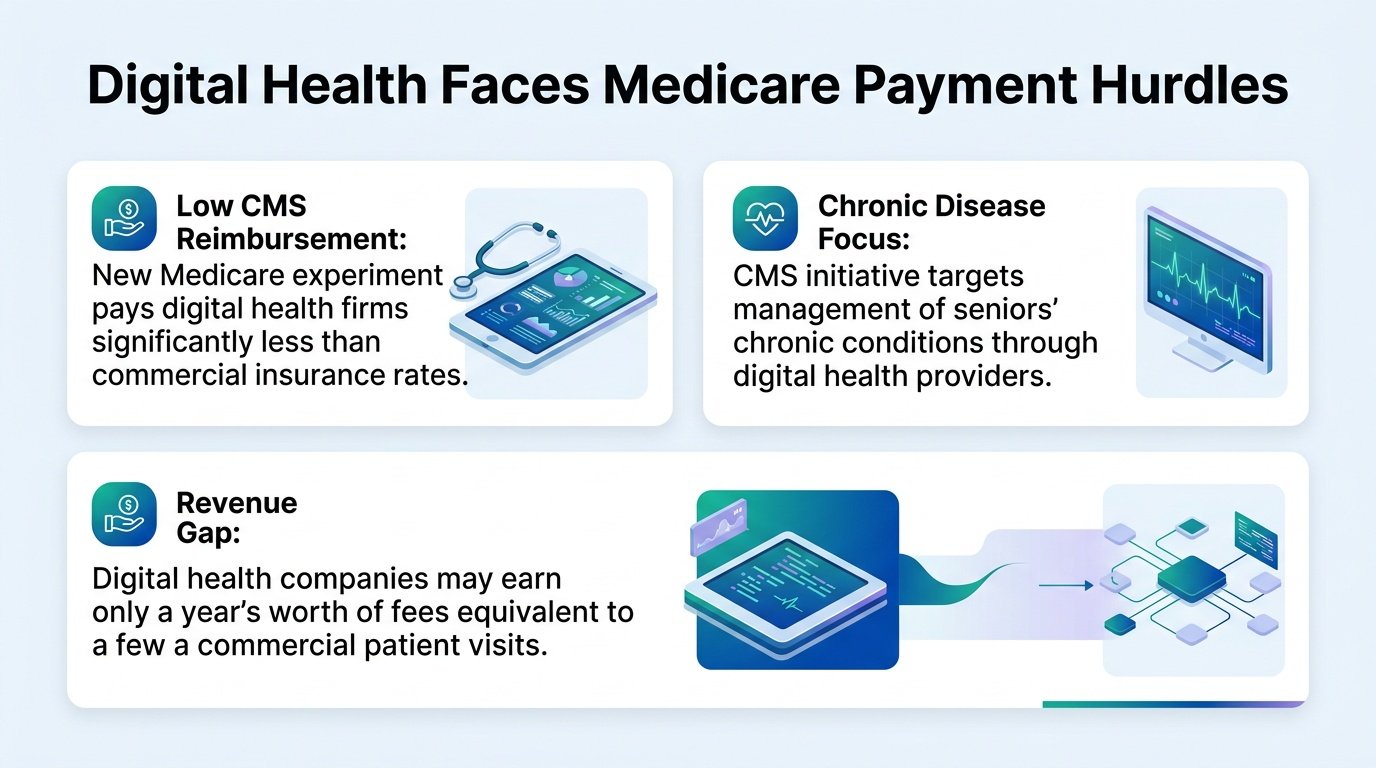
Digital health companies are rushing toward a new Medicare experiment that pays them pennies compared to commercial insurance.
The Centers for Medicare & Medicaid Services just launched its ten-year ACCESS model. It represents a massive shift toward outcome-aligned payments. Up to 50 percent of reimbursement is now tied directly to measurable clinical improvements in patients with chronic conditions like diabetes and depression.
But there is a major catch. The financial math is brutal.
The Price of Scale
Medicare will pay some digital health firms about as much for an entire year of care as they would get from a commercial insurer for just two patient visits. Yet, tech companies are not walking away. They are lining up to get in.
Why accept low margins? Because government programs offer unmatched scale. Winning in Medicare means proving a tool works across millions of patients. It is a long-term play to establish interoperability and secure a permanent foothold in public healthcare.
A Regulatory Shortcut
To sweeten the deal, the FDA introduced the TEMPO pilot. This allows companies to use certain digital health devices under ACCESS before they receive full premarket authorization. It is a regulatory fast-track designed to offset the low initial payments.
But the risk is entirely on the developers. If their tech fails to deliver actual clinical outcomes, they lose half their revenue. For years, digital health thrived on high-margin commercial contracts. The ACCESS model forces a pivot to low-margin, high-volume public health. This model will quickly separate clinically viable tools from expensive software novelties.