

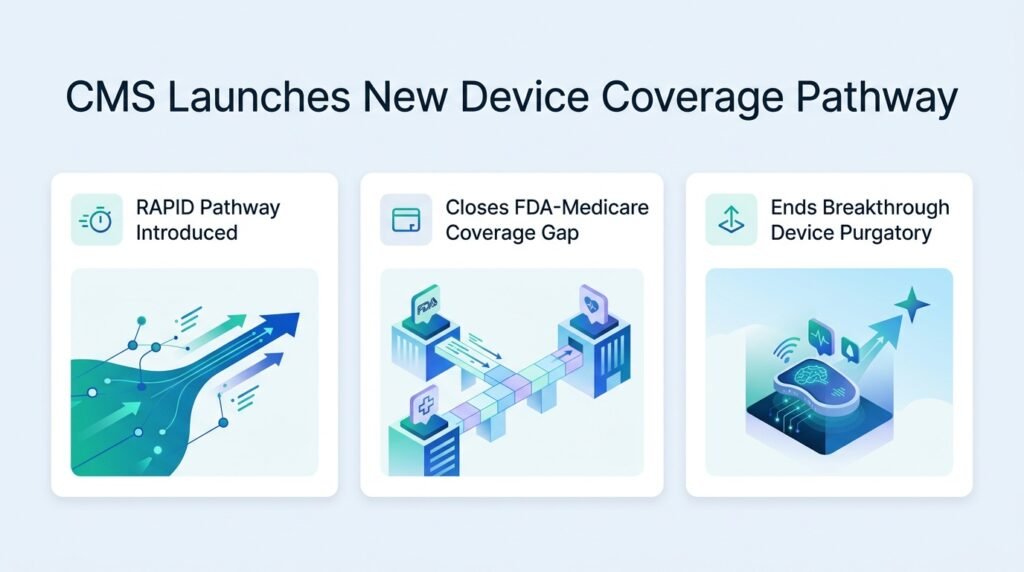
The federal government’s new plan to rescue medical devices from regulatory limbo comes with a hidden catch that could leave many innovators behind.
For years, medical device manufacturers have faced a brutal reality. Winning FDA approval is only half the battle. The real hurdle is securing Medicare coverage, a secondary negotiation that often drags on for years in what the industry calls coverage purgatory.
The New Fast Track
The joint CMS-FDA RAPID pathway aims to compress this agonizing delay to as little as two months. By aligning clinical evidence expectations early in the development cycle, regulators hope to sync approval with reimbursement. On paper, it is a massive win for patient access.
But this speed comes at a steep price. The eligibility criteria are highly restrictive. Class II devices must participate in the TAP program, while Class III devices must undergo rigorous IDE studies. Analysts estimate these bottlenecks will limit the pathway’s initial reach to only dozens of devices.
The Hidden Cost
The real sting lies in what is being taken away. To launch RAPID, CMS repealed the fast-track alternative pathway for Breakthrough Devices to receive New Technology Add-On Payments (NTAP).
Now, these advanced tools must meet standard, high-bar clinical-improvement tests to secure extra funding. By closing the coverage gap for a select few, regulators have erected new financial hurdles for the rest. Innovators must now weigh the benefit of faster coverage against the loss of guaranteed early-stage funding. It is a calculated trade-off that may stifle smaller startups.
This shift signals a broader regulatory philosophy. CMS is no longer willing to pay a premium for novelty alone. If you want fast access, you must prove clinical value early and accept strict oversight. For the medical device sector, the regulatory maze has not disappeared. The walls have simply moved.