New AI Automates Clinical Research in Hours
A new AI system called MedGenesis can compress years of clinical research into hours by autonomously generating hypotheses and analyzing patient data.
How long should it take to discover a biological mechanism that fights cancer? Historically, the answer is years of fragmented literature reviews, trial designs, and lab failures.
A new AI system challenges the assumption that clinical research must move at this glacial pace.
By treating clinical discovery as a closed-loop reasoning problem, MedGenesis suggests that the bottleneck in medicine is not data generation, but the speed of logical inference. This shifts the role of the human scientist from investigator to validator.
How the AI works
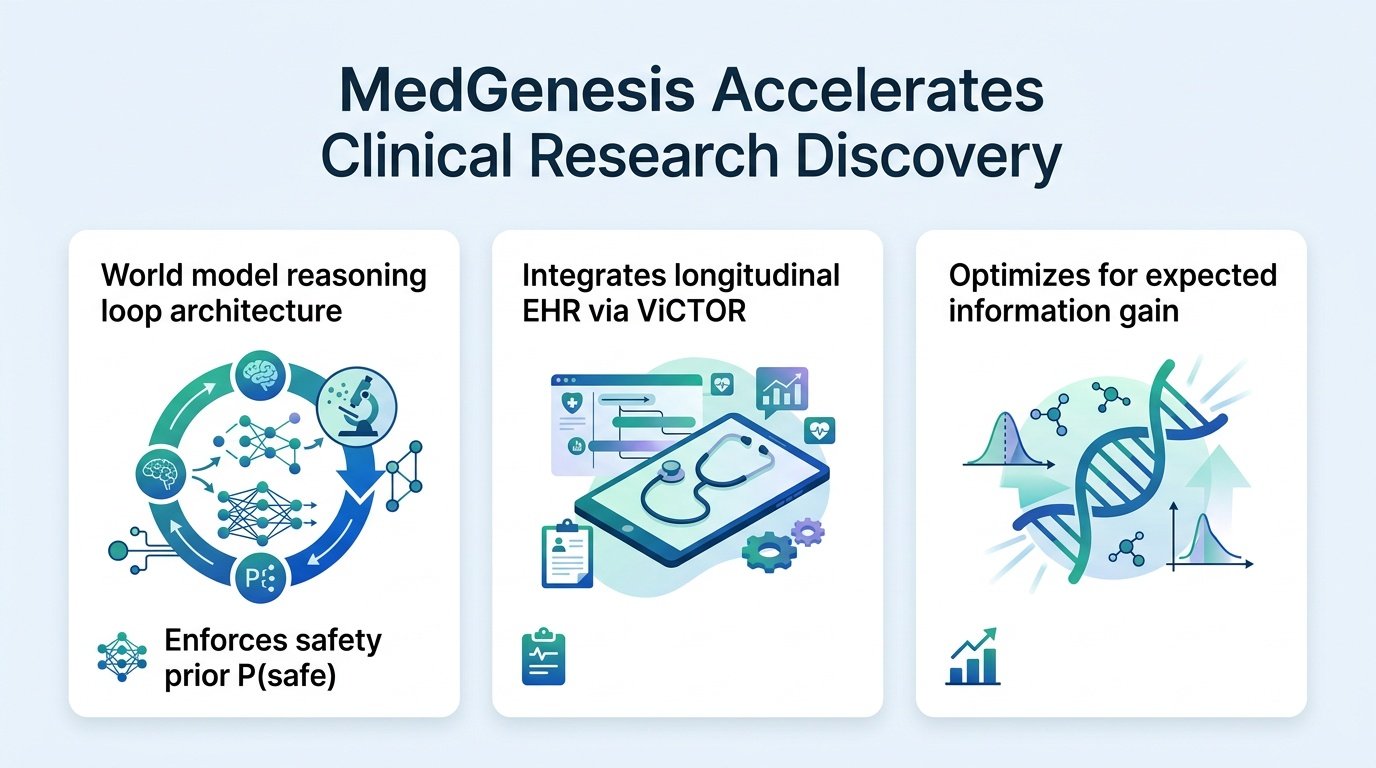
The system uses a world-model reasoning loop to update what it calls a Latent Hypothesis Space and a Latent Action Space. It evaluates clinical data using expected information gain, uncertainty reduction, and safety constraints. To handle complex patient histories, it relies on a representation tool called ViCTOR to process longitudinal electronic health records for cohort retrieval and time-to-event analysis.
This architecture was tested across **1 million** patient observations spanning five evidence formats, including randomized controlled trials and real-world trajectories. In a major validation, the system nominated a **3-hydroxybutyrate – neutrophil axis** that modulates antitumor immunity. This was not just a theoretical guess, as the finding was coupled with wet-lab validation to prove the AI can pinpoint real biological targets.
Beating the benchmarks
To prove its clinical utility, researchers tested MedGenesis against existing models on two new benchmarks.
- It outperformed frontier language models on ClinicalResBench, which contains **1,697** expert-curated questions.
- It successfully completed **40** paper-reproduction tasks on the ClinicalRepBench benchmark.
- It generated traceable, low-hallucination outputs across **5** distinct clinical evidence formats.
This performance builds on a growing trend of using machine learning for evidence synthesis, as discussed in the Journal of Medical Evidence. However, while earlier tools merely summarized existing papers, this system actively generates and tests new hypotheses. It represents a shift toward agentic AI in pharmacology, a concept explored in CPT Pharmacometrics & Systems Pharmacology.
The reality check
Why does this matter? This finding is highly specific because it proves that an AI can autonomously link metabolic pathways to immune responses without human prompting. If AI can reliably identify targets like the 3-hydroxybutyrate axis, drug discovery pipelines can bypass the initial years of speculative literature screening.
Yet, limitations remain. The system relies heavily on the quality of its safety prior and the accuracy of the underlying electronic health records. If the input data contains systemic biases, the AI will simply automate and accelerate those biases at scale. Human oversight remains a bottleneck, as clinical trials still require real-world human safety testing.
Read the full preprint in medRxiv.