
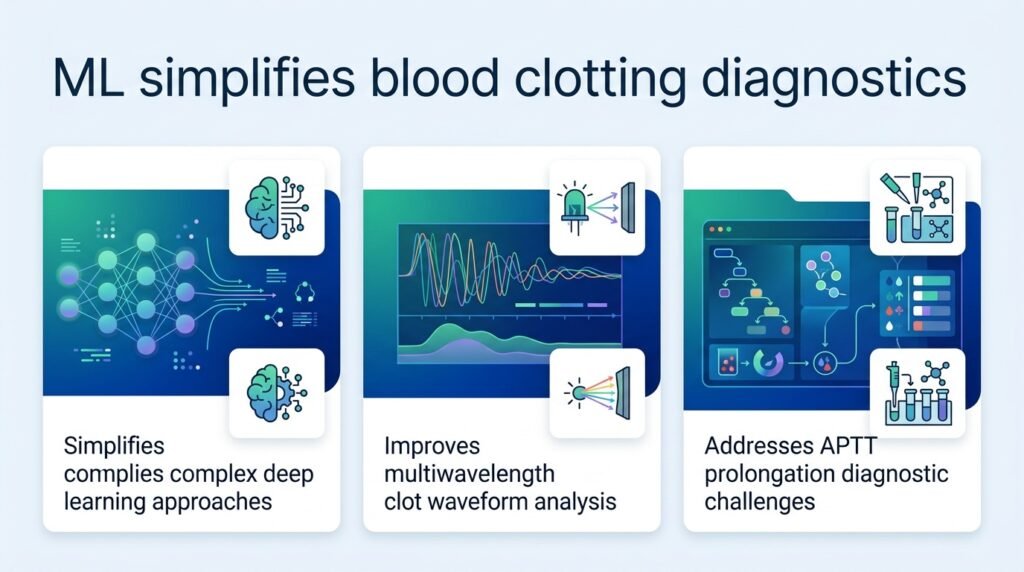
A new machine learning model decodes complex blood clotting delays without the need for opaque deep learning systems.
When a routine blood test shows a delay in clotting, doctors face a diagnostic guessing game. Is the culprit a blood thinner, an autoimmune response, or a genetic bleeding disorder? This diagnostic bottleneck often stalls critical treatment decisions in emergency settings.
For years, the medical AI field has assumed that solving this puzzle requires maximum complexity. Researchers have chased multi-wavelength deep learning models that are highly accurate but notoriously difficult to interpret. This study challenges that “more is better” dogma. By stripping the input down to a single light wavelength and using simpler machine learning, the researchers proved that clinical utility does not require a black box.
The diagnostic bottleneck
A prolonged activated partial thromboplastin time (APTT) is a common clinical finding. Yet, the delay itself does not tell clinicians why the blood is failing to clot. To find the root cause, labs must run a battery of expensive, time-consuming secondary tests.
To train a smarter tool, researchers gathered 683 prolonged APTT samples. They classified these into five distinct clinical categories: heparin (99 samples), direct oral anticoagulants (249 samples), warfarin (105 samples), lupus anticoagulant (95 samples), and factor VIII/IX deficiencies or inhibitors (135 samples).
Simpler data, better clarity
Instead of feeding massive datasets into a deep neural network, this model analyzed just 22 waveform-derived parameters at a single light wavelength of 660 nm. This transition from deep learning to simpler machine learning is the real story here. It means the system can run on standard automated coagulation analyzers already sitting in hospital labs, bypassing the need for specialized computing infrastructure.
The performance metrics show that simplifying the input did not compromise the output:
- The model achieved a diagnostic sensitivity of 82.8% to 99.0% across all five patient categories.
- It maintained a specificity of greater than 95%, which is vital for avoiding costly false positives.
- An independent validation set of 53 patient samples confirmed these high accuracy rates.
Why interpretability matters
In medicine, a highly accurate model is useless if clinicians cannot trust how it reached its conclusion. Deep learning models often hide their decision-making process in layers of digital abstraction. By utilizing single-wavelength clot waveform analysis, this approach links specific mathematical parameters directly to physical clotting behaviors. Clinicians can actually see how the waveform shape changes based on the underlying pathology.
Of course, hurdles remain. The validation cohort of 53 patients is relatively small, and the model must still prove its mettle in diverse, real-world hospital workflows. But the takeaway is clear. We do not always need more complex neural networks to improve patient care; sometimes, we just need to look at the data we already have through a sharper lens.
Read more in the original study published in Scientific Reports.