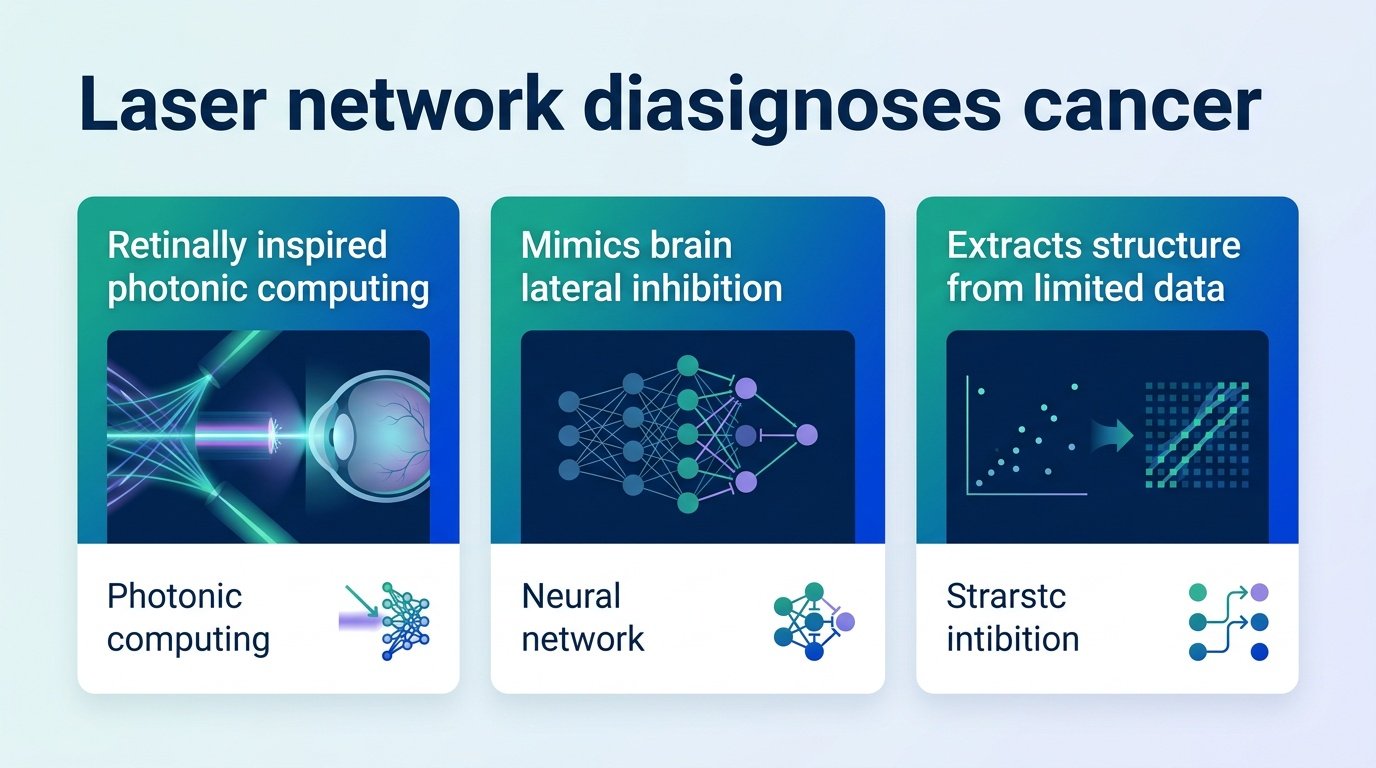
A new light-based computer mimics the human eye to diagnose cancer using only a fraction of the data required by standard AI.
Can a laser beam spot a tumor better than a supercomputer? Standard medical AI is famously data-hungry, requiring millions of images to learn what a disease looks like. This massive appetite for data creates a bottleneck for rare diseases where clinical examples are scarce. It also makes deployment in rural clinics with limited internet access nearly impossible.
This new approach challenges the assumption that better medical AI requires larger cloud-based models. Instead of throwing more computing power at the problem, researchers built a physical system that processes light like a biological retina. It suggests the future of clinical diagnostics might not live in massive data centers, but in specialized, low-power hardware that mimics biological structures.
How the laser thinks
The hardware uses a random network laser to mimic lateral inhibition. This is the biological process where eye cells suppress neighboring signals to highlight sharp edges. Spatially competing lasing modes act as physical neurons, handling complex calculations instantly as light passes through the material.
Because the physics of the laser does the heavy lifting, the system learns with very little training. The system outperformed heavy-duty software models when training data was limited to just a few hundred images. This physical setup bypasses the energy-intensive digital processing that slows down traditional neural networks.
The diagnostic results
The system proved highly capable across several standard benchmarks and real-world medical imaging tasks:
- Achieved 90.12% accuracy on the BreakHis breast cancer diagnosis dataset.
- Outperformed state-of-the-art software models like EfficientNetV2 and the vision transformer ViT when trained on only a few hundred images.
- Reached 98.05% accuracy on MNIST and 87.85% on Fashion-MNIST.
- Demonstrated joint segmentation and classification on the HAM10k skin lesion dataset, scoring 84.49% on the DICE index and 74.80% on the Jaccard index.
The physical limits
Do not expect this laser system to replace hospital diagnostic software tomorrow. The physical hardware is still an experimental laboratory setup. Programming these physical networks is notoriously difficult, and scaling them to handle high-resolution clinical scans remains a major engineering hurdle.
But the implications for medical imaging are profound. If diagnostic tools can run on specialized physical hardware, hospitals can analyze biopsy slides locally without uploading sensitive patient data to the cloud. This shifts the bottleneck from data collection to hardware design, proving that physical computing can compete with digital giants.
This research was published in Science Advances.