
A machine learning model triages heart failure in COPD patients using basic blood tests, but it misses too many cases to replace standard cardiac biomarkers.
Heart failure is frequently missed in patients with chronic obstructive pulmonary disease because overlapping symptoms disguise cardiac decline. Researchers attempted to catch comorbid heart failure early by training an elastic net algorithm strictly on 12 routine laboratory indicators.
The resulting tool proves that standard blood draws contain actionable diagnostic signal. However, it fails to outshine existing single-biomarker testing, making its main value an automated pre-screening layer rather than a diagnostic replacement. Machine learning has previously helped reclassify complex cardiac conditions, such as work identifying novel pheno-groups in heart failure with preserved ejection fraction. Yet in routine triage, clinical software must beat cheap, direct measures.
Algorithm performance across cohorts
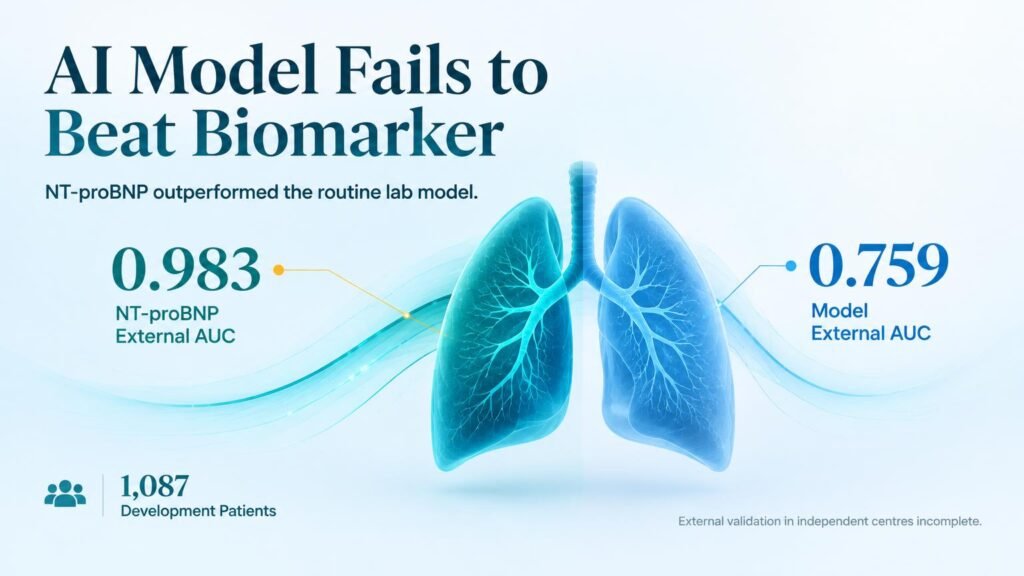
The study evaluated hospitalized patients across two distinct timeframes. The development cohort included 1,087 COPD patients admitted between January 2023 and December 2025, of whom 292 had clinically documented heart failure. Researchers screened 25 candidate predictors down to 12 routine laboratory markers.
A temporal validation cohort followed 268 patients admitted between January and September 2026, including 63 heart failure cases. The elastic net model achieved a development AUC of 0.817, an optimism-corrected AUC of 0.799, and an external validation AUC of 0.759. External calibration remained steady with an intercept of -0.133 and a slope of 0.958.
Key findings and trade-offs
- The model achieved an external validation AUC of 0.759 using 12 routine lab tests.
- A single NT-proBNP blood test reached an external AUC of 0.983, vastly outperforming the algorithm.
- At a 90% sensitivity threshold, the model cleared 36.6% of validation patients from immediate echocardiography.
- That same threshold missed 17.5% of heart failure cases, leaving 11 of 63 patients undetected.
The real-world trade-off
A screening tool that misses 17.5% of target cases creates clear clinical risk. When NT-proBNP testing alone achieves an AUC of 0.983, the 12-variable algorithm adds zero diagnostic power where natriuretic peptide testing is already available.
Similar predictive limits appear when modeling pulmonary risks, such as using explainable machine learning for acute COPD exacerbation. Models built on passive EHR data must accept higher error rates to achieve zero added cost.
That zero-marginal-cost profile defines the tool’s actual utility. It can run continuously in the background on basic lab panels to flag patients who require NT-proBNP testing and echocardiography. Single-center retrospective validation remains a major limitation, requiring prospective testing across independent hospitals before clinical use.
Read the full study in BMC Cardiovascular Disorders.