AI and Novice Monitors Match Brain Experts
Pairing untrained staff with artificial intelligence could solve the specialist shortage in operating rooms.
During high-risk neck surgery, a patient’s brain can quietly starve of oxygen. Spotting this silent stroke in real time requires a rare commodity: a highly trained neurophysiologist staring at complex brainwaves. When none are available, hospitals face a dangerous compromise.
A new study challenges the assumption that we must choose between scarce human experts and flawed, fully automated algorithms. By blending both, researchers achieved expert-level safety without the expert. This suggests the immediate future of clinical AI is not total automation, but the smart augmentation of cheaper labor.
The Human-AI Sweet Spot
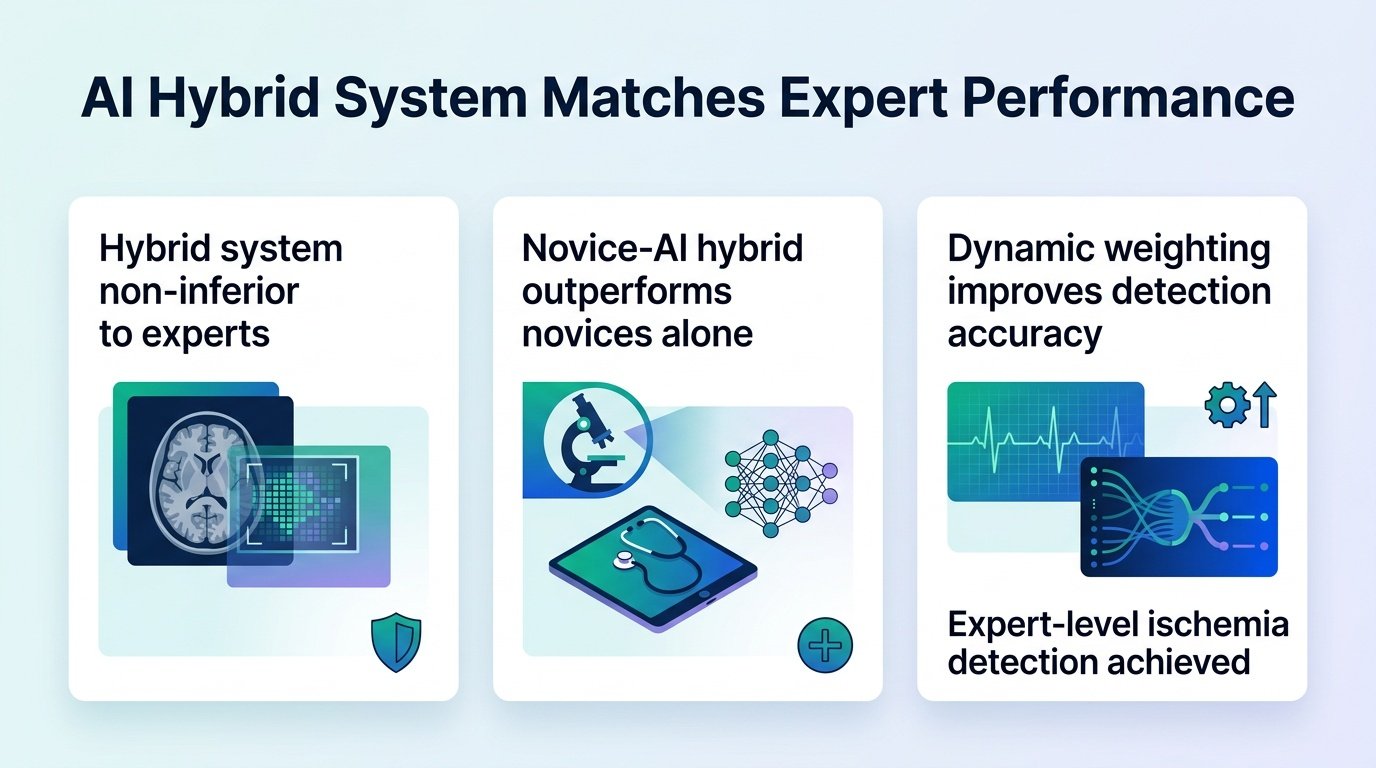
Researchers tested this hybrid approach during carotid endarterectomy, a procedure carrying a high risk of brain ischemia. They paired four novices who had minimal training in continuous electroencephalography (cEEG) with an AI model. The system dynamically weighted the human and machine inputs to make a final call.
The hybrid team held its own against the gold standard. It was statistically non-inferior to human experts in both sensitivity and false-positive rates. Novices working alone failed to match the experts, proving that the algorithm was doing the heavy lifting.
But the real surprise was how much the human-AI pairing improved on the AI alone. At 80% sensitivity, the hybrid system cut the false-positive rate in half compared to the standalone AI. It showed a similar halving of false alarms at 90% sensitivity.
The Hard Numbers
The hybrid system consistently outperformed the algorithm acting on its own across every key metric:
- The area under the precision-recall curve rose from 0.546 to a range of 0.610 to 0.726.
- The area under the receiver operating characteristic curve ticked up from 0.957 to between 0.967 and 0.971.
- System calibration improved, meaning the confidence of the alerts aligned much better with actual patient risk.
Why This Matters
This finding complicates the popular narrative that AI will simply replace human clinicians. Instead, it shows that humans and algorithms fail in different ways, and their strengths are complementary. The AI brings tireless pattern recognition, while the novice human provides a baseline of common-sense filtering that keeps the algorithm from crying wolf.
This matters because it shifts the bottleneck of surgical safety. If a minimally trained monitor with a smart copilot can watch brainwaves safely, hospitals can scale high-quality monitoring to underserved regions. It lowers the barrier to entry for complex care.
The Reality Check
This is a preprint, so the findings still face peer review. The study is also small, relying on just four novices. We do not yet know how this hybrid system performs during rare, unexpected surgical complications that might confuse both the novice and the software.
Read the full preprint in medRxiv.