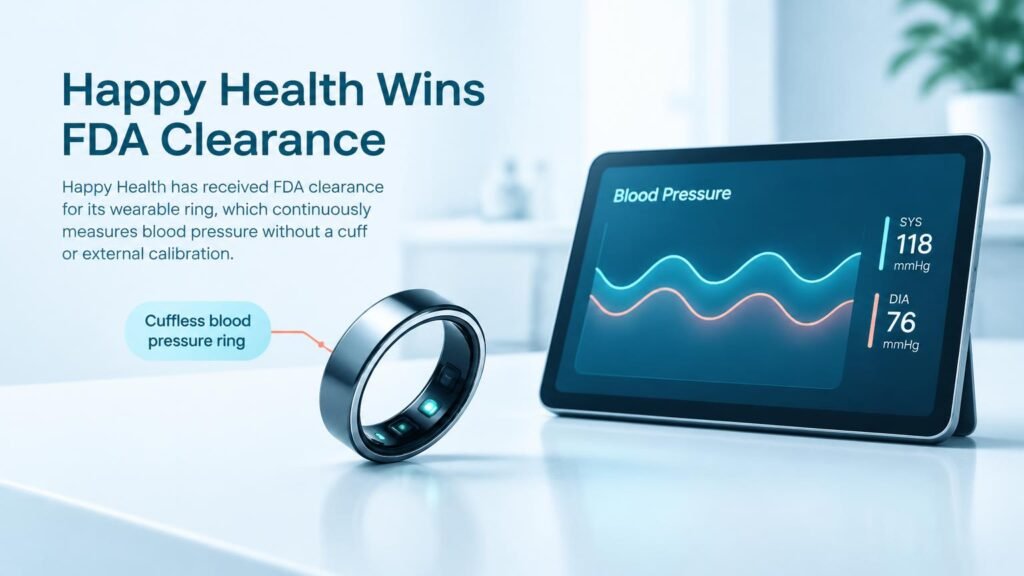
Continuous blood pressure tracking no longer requires an inflating arm cuff or manual calibration.
Regulators have granted clearance to Happy Health for a smart ring that measures blood pressure passively from the finger. The decision moves continuous cardiovascular monitoring out of the clinic and into daily life.
Ditching the Calibration Step
Most wearable blood pressure prototypes rely on machine learning algorithms trained to estimate pressure based on occasional cuff measurements. This new device uses direct optical and biophysical sensors to calculate readings. It was validated against invasive arterial-line standards across an 85-patient clinical trial.
Continuous passive tracking eliminates the white-coat effect and captures nocturnal blood pressure spikes. These nocturnal readings are critical indicators of stroke and heart attack risk that static cuff measurements routinely miss.
Accuracy Beyond Single-Site Trials
While an arterial-line comparison provides strong validation, an 85-patient trial setting leaves long-term, real-world utility unproven. Regulatory clearance confirms diagnostic measurement accuracy, but it does not prove that continuous remote monitoring automatically improves patient outcomes or reduces hospitalizations.
Clinicians gain a continuous stream of outpatient data without increasing patient burden. However, health systems must now determine how to integrate this deluge of raw telemetry into existing workflows without overwhelming care teams.