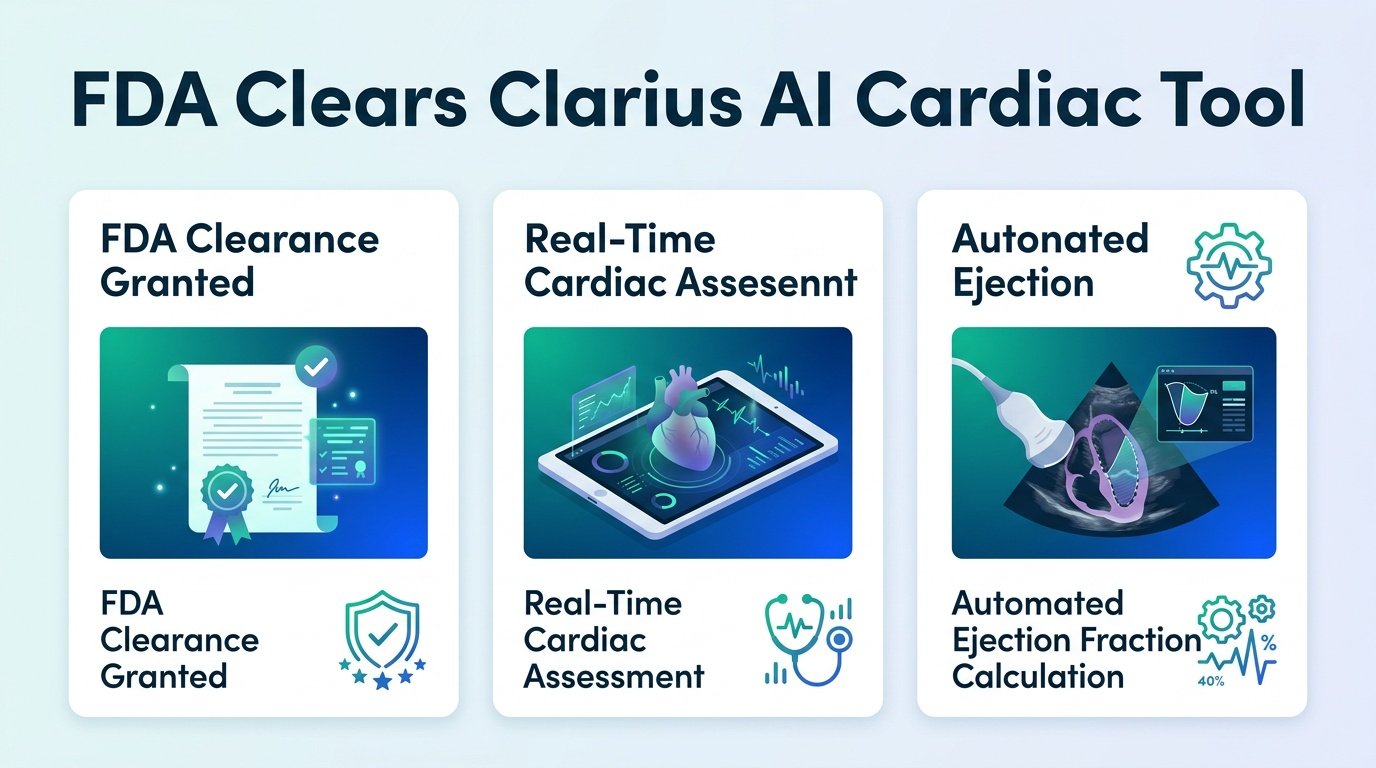
Point-of-care cardiac assessment is moving from subjective clinical guesswork to automated, real-time quantification.
For decades, emergency physicians and rural clinicians have relied on “eyeballing” ultrasound screens to estimate how well a patient’s heart pumps blood. This subjective estimation is fast, but it is notoriously prone to human error and variation between observers.
The End of Eyeballing
A new regulatory milestone shifts this dynamic. The FDA has cleared Clarius Mobile Health’s Ejection Fraction AI, an automated tool integrated directly into its wireless handheld ultrasound app to calculate left ventricular function in real-time.
Instead of waiting hours for a formal cardiology consult, clinicians can now get objective data at the bedside. This is particularly critical in emergency resuscitation, where vital decisions must be made within a tight 90-second window.
The Acquisition Bottleneck
But automated calculations are only as good as the clinician holding the probe. Handheld ultrasound has long promised to democratize diagnostics, but image acquisition remains a highly skilled physical act.
If a novice clinician captures a poor view of the heart, even the most sophisticated algorithm will output flawed data. The technology reduces the cognitive load of interpretation, but it does not solve the physical challenge of scanning. Training, not just software, remains the bottleneck.
For health systems, this clearance signals a broader trend. Handheld devices are no longer just cheaper, portable alternatives to cart-based systems. They are becoming intelligent diagnostic nodes capable of rapid, objective triage.