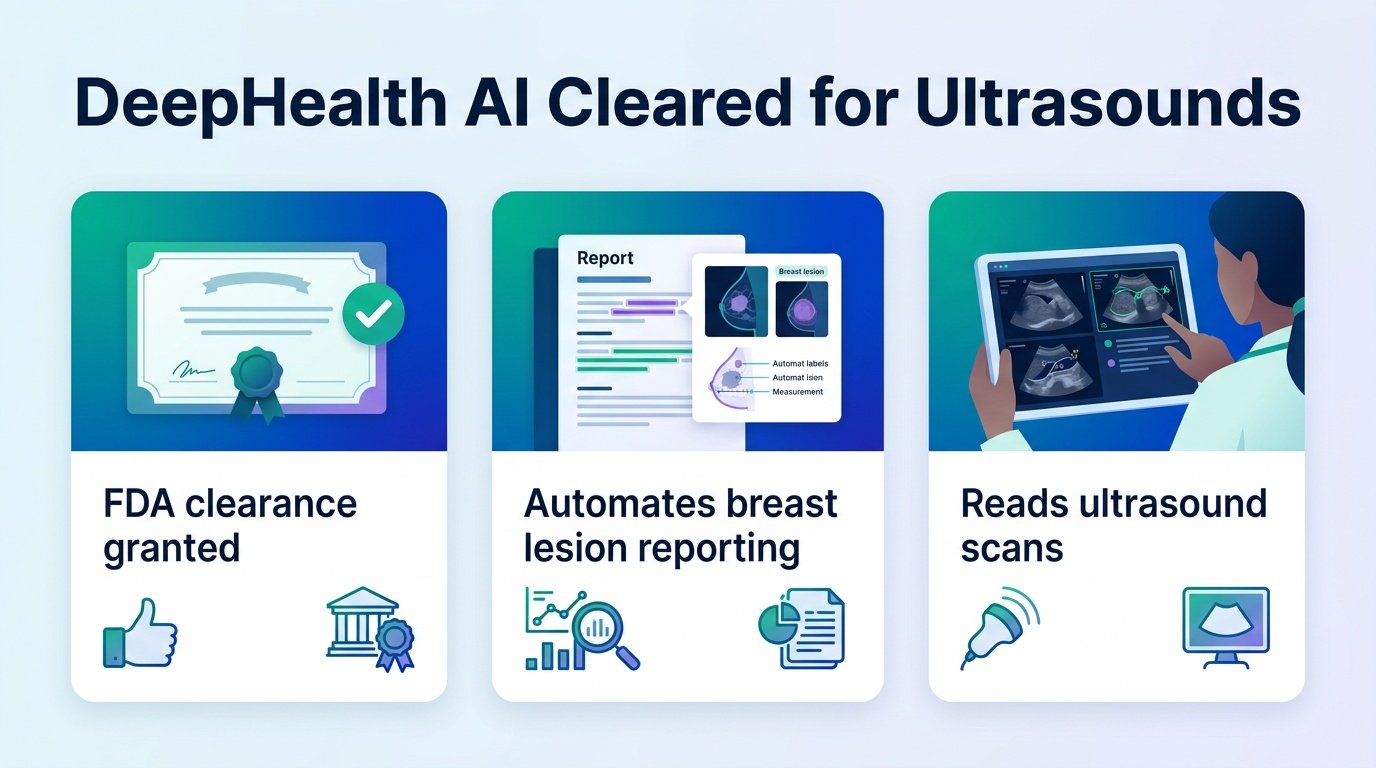
Automating ultrasound analysis could finally break the bottleneck in breast cancer screening.
Ultrasound is notoriously operator-dependent and time-consuming. While mammography has seen rapid AI adoption, ultrasound has remained a manual, highly variable specialty. Radiologists spend hours squinting at gray-scale static images trying to differentiate benign cysts from malignant masses. This variability leads to high recall rates and unnecessary biopsies.
The FDA clearance of DeepHealth’s breast ultrasound tool changes the math by targeting the workflow itself.
The Efficiency Play
By automating lesion detection and drafting reports, the software cuts radiologist interpretation times by 37 percent. It also boasts a 98 percent accuracy rate for locating lesions and boosts cancer detection sensitivity by 8 percent.
This is not just about clinical accuracy. It is about throughput.
RadNet plans to deploy this across its entire US network, potentially affecting 700,000 annual exams by the end of the year. In a market facing a severe shortage of radiologists, saving over a third of reading time per scan is a massive operational win.
The Reimbursement Hurdle
But deployment is only half the battle.
The tool qualifies for reimbursement under an existing Category III CPT code. These temporary codes are notoriously difficult to convert into consistent, widespread payer coverage. Without permanent codes, long-term financial viability remains uncertain.
If insurers balk, the financial burden of this automation will fall entirely on imaging centers. AI is ready to read the scans. Now, the reimbursement system must prove it is ready to pay for them.