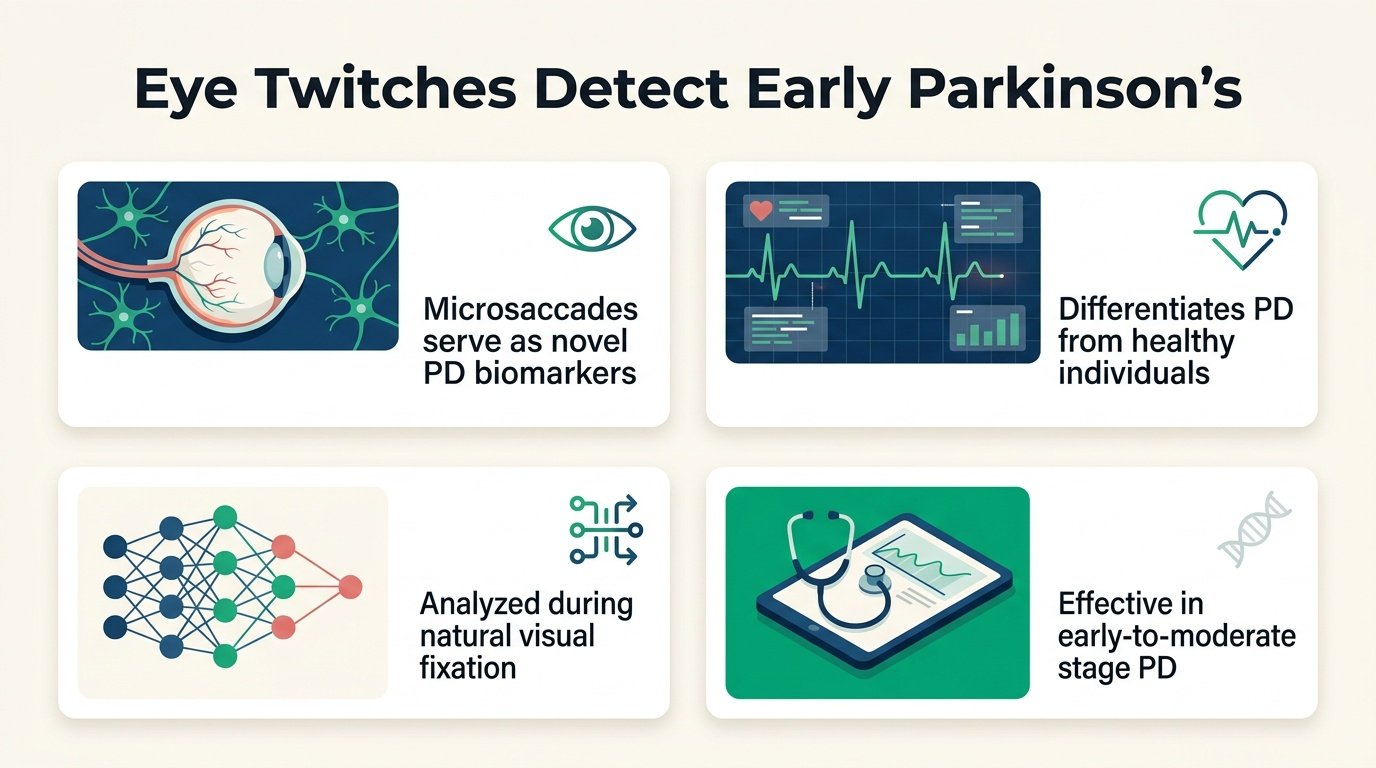
Tiny, involuntary eye movements captured without head restraints can train algorithms to flag early Parkinson’s disease.
Can a computer spot Parkinson’s disease just by watching your eyes twitch for a few seconds? For decades, capturing these microscopic eye movements required heavy, uncomfortable chin rests to keep the head perfectly still. This setup made clinical eye-tracking impractical for routine medical checkups.
A new study challenges this rigid requirement. Researchers proved that machine learning can spot the disease even when patients move their heads naturally. If diagnostics can escape the specialized lab, screening for neurodegenerative diseases becomes vastly more accessible.
How the eyes twitch
Researchers tracked the eye movements of 50 patients with early-to-moderate Parkinson’s disease and 43 healthy controls. During a simple visual fixation task, the participants sat naturally without any physical head restrictions. The team focused on microsaccades, which are involuntary, microscopic eye jumps that happen when we try to stare at a fixed point.
The data revealed that Parkinson’s leaves a distinct signature on these tiny movements. Specifically, the researchers observed three key differences in the diseased group:
- Microsaccades occurred more frequently than in healthy eyes.
- The involuntary jumps had larger amplitudes.
- The eye movements showed a stronger horizontal bias.
The algorithmic diagnostic
To see if these patterns could serve as a reliable diagnostic tool, the team trained several machine learning models. A polynomial support vector machine achieved a classification accuracy of 77.4% on held-out test subjects. The model demonstrated a balanced sensitivity of 76.1% and a specificity of 78.9%.
The researchers also introduced a clever data-filtering step. By discarding individual eye-movement predictions that had low confidence, they boosted the overall accuracy at the patient level. This approach helps clean up the messy data that naturally occurs when people are allowed to move their heads.
The clinical reality check
An accuracy rate of 77.4% is a strong baseline, but it is not yet ready for standalone clinical triage. In a real-world clinic, a one-in-four error rate would cause too many false alarms and missed cases. This tool is not a replacement for a neurologist.
Instead, the true value of this finding is proof of concept. It proves that natural, unrestrained eye tracking still yields highly diagnostic data. This opens the door for passive, low-cost screening tools that could run on standard tablets in primary care offices.
The next major hurdle is specificity. The algorithm must be tested against other movement disorders, like essential tremor or progressive supranuclear palsy. If the software cannot tell these conditions apart, its real-world utility will remain limited.
Read the full study in Translational Vision Science & Technology.