
Title: AI colposcopy tool reduces unnecessary biopsies
An independent validation of an AI colposcopy tool shows it closes the expertise gap and prevents unnecessary tissue sampling.
How do we know if medical AI actually works when it leaves the lab? Most diagnostic algorithms look brilliant in internal testing, only to stumble when facing messy, real-world data. This is the overfitting trap that keeps clinical software on the sidelines.
A new study in *npj Digital Medicine* challenges this bottleneck by testing an AI-guided colposcopy system on an independent dataset. The results suggest that AI’s true value is not replacing senior specialists, but leveling the playing field for junior clinicians. It turns average diagnosticians into highly accurate ones.
Testing the algorithm
Researchers evaluated the AI using an external WHO dataset of 187 patients and 855 colposcopic images. To test real-world utility, 45 colposcopists with varying experience levels from 12 regions in China reviewed the cases. This setup directly builds on earlier efforts to build deep learning classifiers for cervical images, such as those detailed in the Annals of Translational Medicine.
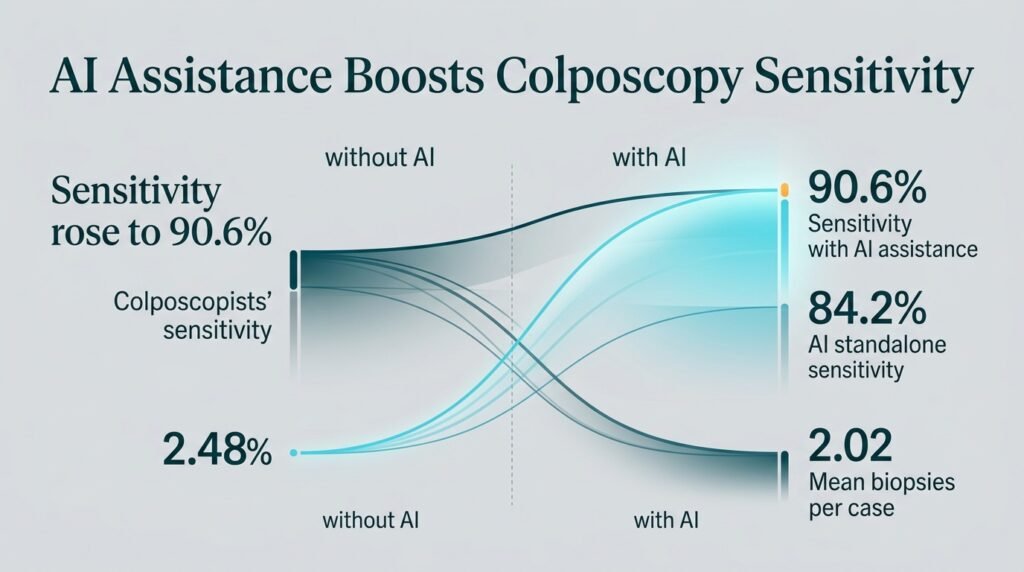
On its own, the AI achieved a standalone sensitivity of 84.2% (95% CI 74.4–90.7%) for detecting cervical intraepithelial neoplasia grade 2 or worse (CIN2+). But the real magic happened when humans and machines worked together.
Closing the expertise gap
When clinicians used the AI, their collective diagnostic performance shifted significantly. The tool acted as an equalizer across different clinical settings.
- Overall sensitivity rose from 84.8% (95% CI, 82.7–86.9%) to 90.6% (95% CI, 88.7–92.1%).
- Low-experience clinicians saw their sensitivity jump by 6.5%.
- Junior clinicians’ area under the curve (AUC) improved from 0.72 (95% CI, 0.68–0.77) to 0.76 (95% CI, 0.72–0.80) with a p-value of 0.043.
- The average number of biopsies per case fell from 2.48 to 2.02.
This biopsy reduction is the most critical clinical takeaway. Over-biopsying causes patient anxiety, physical discomfort, and unnecessary healthcare costs. By narrowing the target area, the AI makes the procedure less invasive. This clinical utility echoes earlier findings on AI-guided biopsy selection published in BMC Medicine.
The road ahead
The study is not without limitations. While the WHO dataset provides a robust external benchmark, 187 patients is a relatively small cohort. The retrospective nature of the image library also means we cannot see how the AI performs in real-time, high-pressure clinical environments.
Even so, the data proves that AI can successfully export its expertise. By boosting junior doctors to near-expert levels, this technology could standardize cervical care in clinics that lack veteran specialists.
Source: npj Digital Medicine