AI Separates Menopause From Long COVID
A new language model attempts to solve a major diagnostic bias by separating normal hormonal transitions from actual viral damage in women.
Is it Long COVID, or is it just menopause? For millions of women, clinical algorithms cannot tell the difference. This diagnostic blind spot does more than skew medical data. It misdirects treatment.
The diagnostic overlap
For years, medical AI has struggled with female-specific health data. Post-acute sequelae of SARS-CoV-2 (PASC), commonly known as Long COVID, disproportionately affects women. However, its hallmark symptoms—including **insomnia, fatigue, palpitations, and cognitive difficulty**—heavily overlap with comorbidities and natural hormonal transitions like menopause.
This is not just an academic debate. When an algorithm misdiagnoses the root cause of fatigue, patients suffer. A woman experiencing menopausal transition might be put on unnecessary antiviral regimens, while her actual hormonal needs go ignored.
This overlap creates a massive confounding problem. When standard models forecast future symptom severity, they risk attributing baseline physiological noise to viral pathology. The machine sees a racing heart or a sleepless night and blames the virus, ignoring the patient’s age and hormonal status.
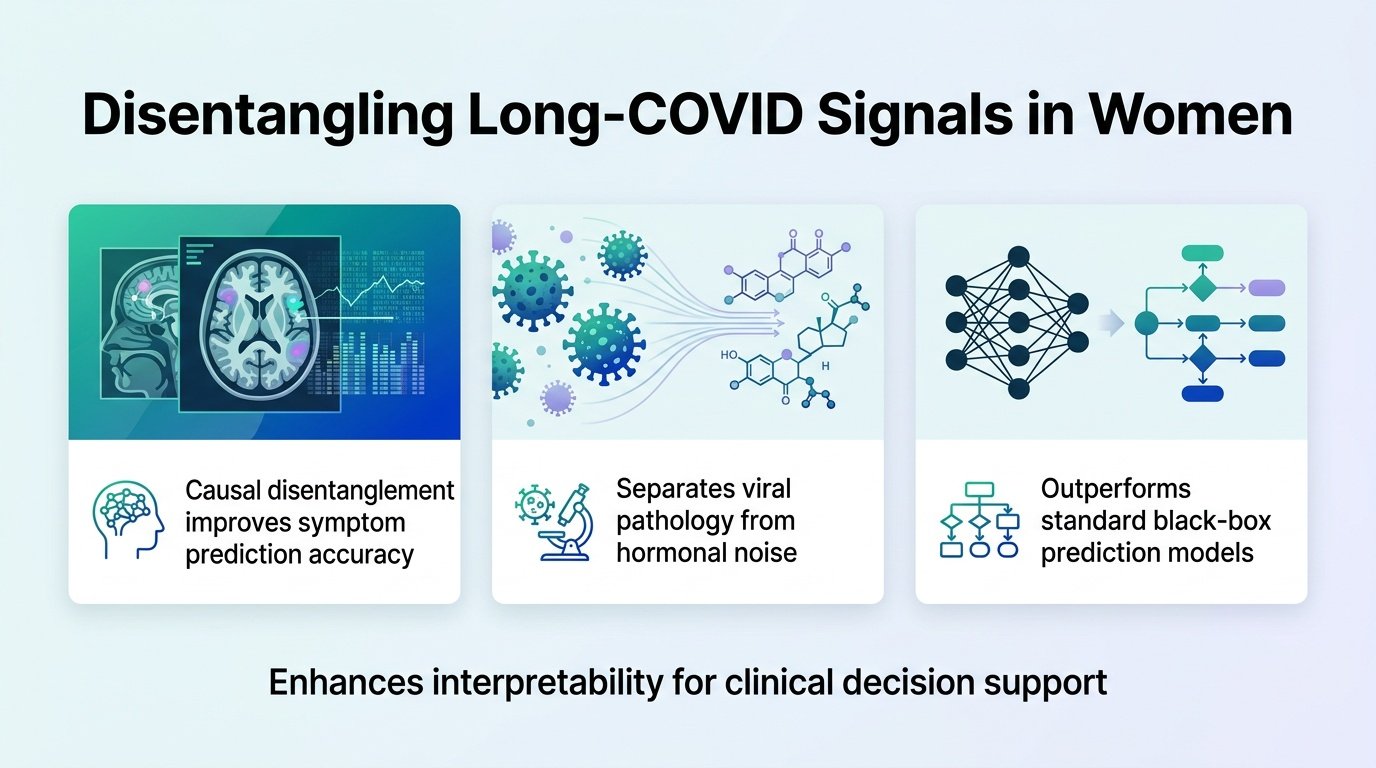
To address this, researchers developed an interpretable, causally disentangled language model. The system aims to separate true pathological signals from these natural confounding factors.
How the model works
The core innovation is causal disentanglement. Instead of simply looking for patterns, the model tries to understand the “why” behind the symptoms.
- It isolates **true pathological signals** of Long COVID from baseline physiological noise.
- It prevents the misattribution of **menopause-related insomnia and fatigue** to viral damage.
- It remains competitive with standard, non-disentangled models in predicting **future symptom severity**.
This approach challenges the lazy assumption in healthcare AI that more data automatically equals better tracking. If an algorithm cannot distinguish a hot flash from viral autonomic dysfunction, it is clinically useless for half the population. By explicitly modeling these confounders, the researchers are pushing back against the historical tendency of medicine to treat female physiology as an anomaly.
The clinical reality
There are important limitations to keep in mind. This study is a preprint, and the abstract does not provide raw clinical validation metrics. We still need to see how this model performs in messy, real-world clinical settings where patient histories are often incomplete.
We must also ask how easily this model can scale. Training a language model to understand complex causal relationships requires highly curated data. In many clinics, electronic health records are too disorganized to support this level of analysis.
Even so, the implications are loud and clear. AI developers must stop treating female-specific health transitions as noise to be smoothed over by an algorithm. True precision medicine requires tools that actually understand female biology.
Read the full study in medRxiv.