
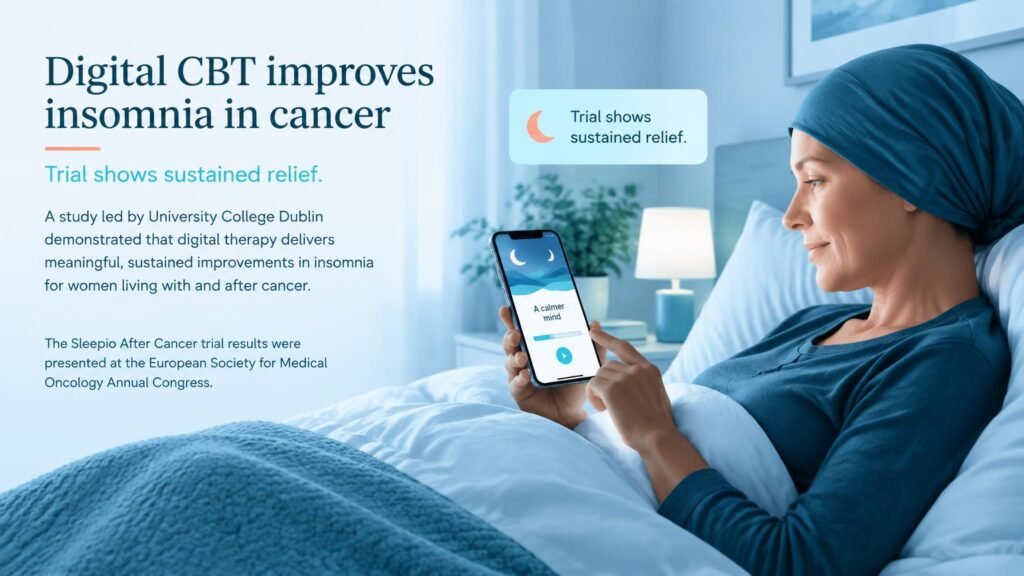
A tailored sleep app doubled insomnia remission rates for cancer survivors compared to basic sleep education.
Insomnia affects up to 60% of cancer survivors, yet access to first-line behavioral therapy remains practically non-existent in routine oncology care. Clinicians frequently default to medication, which carries side effects and fails to address the underlying psychological drivers of chronic sleep disruption.
Clinical Proof at Scale
In a 308-patient randomized controlled trial evaluating the Sleepio After Cancer app, 27% of participants achieved insomnia remission at 24 weeks, compared to just 12% receiving standard sleep hygiene education. The digital cognitive behavioral therapy (dCBT-I) platform also yielded secondary reductions in fatigue, anxiety, depression, and hot flash interference.
This matters because it proves software can deliver specialized behavioral oncology interventions without overloading clinical staff. It shifts sleep care from an unmanageable referral backlog to an automated, scalable prescription.
The Retention Reality
Despite strong efficacy, real-world execution faces a steep hurdle: only 40% of trial participants completed all six prescribed modules. Software accessibility alone does not guarantee patient compliance.
Digital therapeutics can successfully offload specialized care from oncology teams. However, healthcare systems deploying these tools must integrate active adherence tracking rather than assuming digital delivery equals automated patient follow-through.