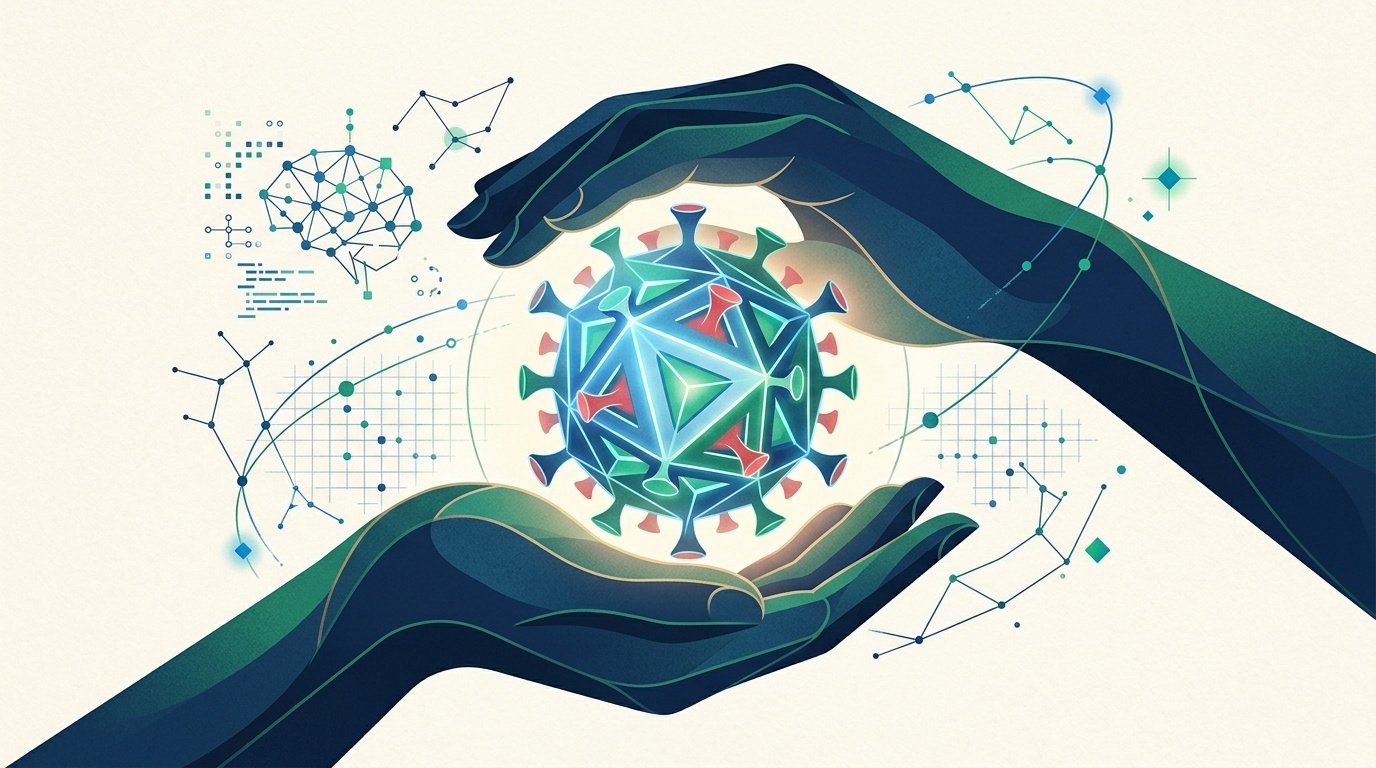
An AI-designed vaccine has cleared its first human trial, but the real test is overcoming our own immune history.
How do you vaccinate against a virus that does not exist yet? Humanity remains trapped in a reactive cycle, chasing mutations with updated boosters. The promise of a universal vaccine has hovered for years, but biology is messy.
The AI Super-Antigen
A newly tested candidate uses machine learning to find the common denominator. Instead of targeting the highly mutable spike protein, researchers used computational models to design a synthetic super-antigen. This structure represents the stable, unchanging features shared across the entire Sarbecovirus family.
The theory is elegant. By training the immune system on this AI-generated blueprint, we could neutralize future animal-borne strains before they spill over into humans.
The Reality Check
But computational elegance often collides with human biology.
While the Phase I trial proved the vaccine is safe and delivered needle-free, the immune response was limited and did not scale predictably with dosage.
Our own immunological history is getting in the way. Most humans now have deep, complex immunity from prior COVID-19 exposures and vaccinations. This existing “immune imprint” can hijack the body’s response, blunting the effect of a novel, computationally designed antigen.
If AI-designed vaccines cannot break through this pre-existing imprint, their real-world efficacy will remain constrained. The upcoming Phase II trials must prove this platform can override our immunological past, not just map a perfect future.