A new multimodal AI model bridges the clinical expertise gap in dentistry by matching the diagnostic accuracy of mid-level practitioners.
Why does dental care still feel like a subjective guessing game? Patients often receive conflicting treatment plans depending on whether they visit a fresh graduate or a veteran specialist. The bottleneck in oral health has never been the imaging technology itself, but rather the uneven distribution of human expertise needed to interpret those scans.
A new study introduces DentVLM, a vision-language model designed to solve this exact bottleneck. This system challenges the prevailing trend of building narrow, single-task medical software. By mastering multiple diagnostic tasks at once, it suggests a future where clinical AI acts as a generalist partner rather than a simple screening tool.
For years, dental software has been relegated to basic cavity-spotting. This trial suggests the active ingredient in modern clinical tools is multimodal synthesis—the ability to look at an X-ray, understand clinical text, and deliver a unified diagnosis. This shifts the goalpost for what we should expect from digital dental assistants.
Broad skills across dental scans
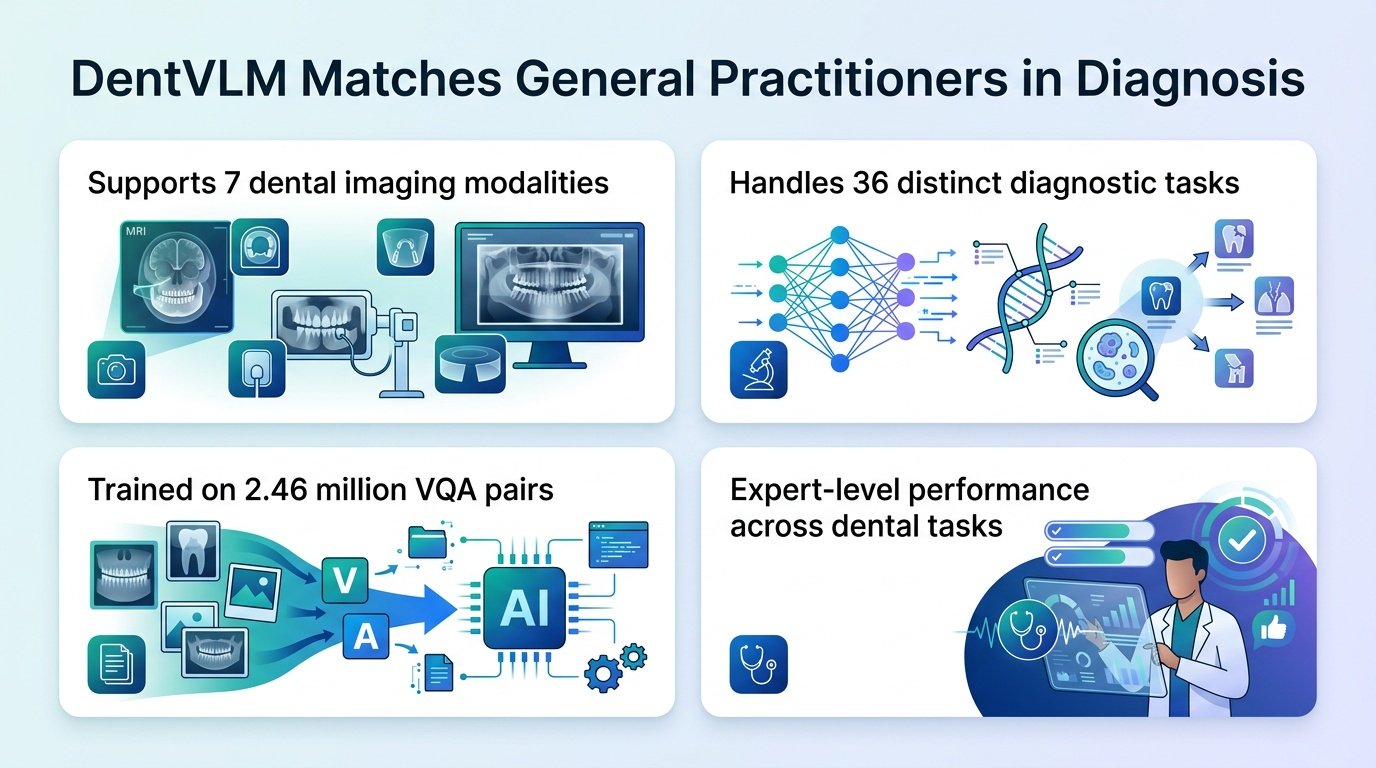
Instead of focusing on a single type of X-ray, the model interprets **seven dental imaging modalities** across **36 different diagnostic tasks**. Researchers trained the system on a massive dataset of **110,447 images** and **2.46 million** bilingual visual question-answer pairs. This broad training allowed the AI to synthesize text and visual data simultaneously.
The system’s performance was evaluated in a study involving **32 participants** with varying levels of clinical experience. The AI consistently outperformed junior readers and matched the diagnostic accuracy of intermediate general practitioners. Most notably, its performance closely approached that of senior dental specialists.
Faster decisions at the chair
The true value of this technology is not its ability to operate in isolation, but how it elevates human clinicians. When dentists collaborated with the AI, the clinical workflow changed significantly.
- The model raised junior and intermediate readers to **specialist-level performance**.
- It reduced diagnostic time by **15.0% to 37.0%** across all clinical readers.
- It maintained high accuracy across both internal and external validation testing.
Saving up to **37.0%** of diagnostic time directly alters the economics of busy dental clinics. It allows practitioners to spend more time on patient care and less time squinting at gray-scale pixels. This efficiency is highly specific to dental workflows, where clinicians must rapidly cycle through dozens of patient charts daily.
However, some skepticism is warranted. A trial of **32 participants** is too small to predict how the software will perform across diverse, global patient populations. Real-world clinics are chaotic, and a model that excels in a controlled test environment may face integration hurdles when plugged into legacy electronic health record systems.
We also need to see how the model handles complex, overlapping pathologies. While it mastered **36 tasks**, clinical reality often presents patients with a messy combination of gum disease, decay, and structural issues all at once. How the AI prioritizes these competing issues remains an open question.
Even with these limitations, the study proves that dental AI is moving past simple detection. By merging vision and language, these systems are beginning to replicate the holistic reasoning of a human specialist.
Read the full study in Nature Communications.