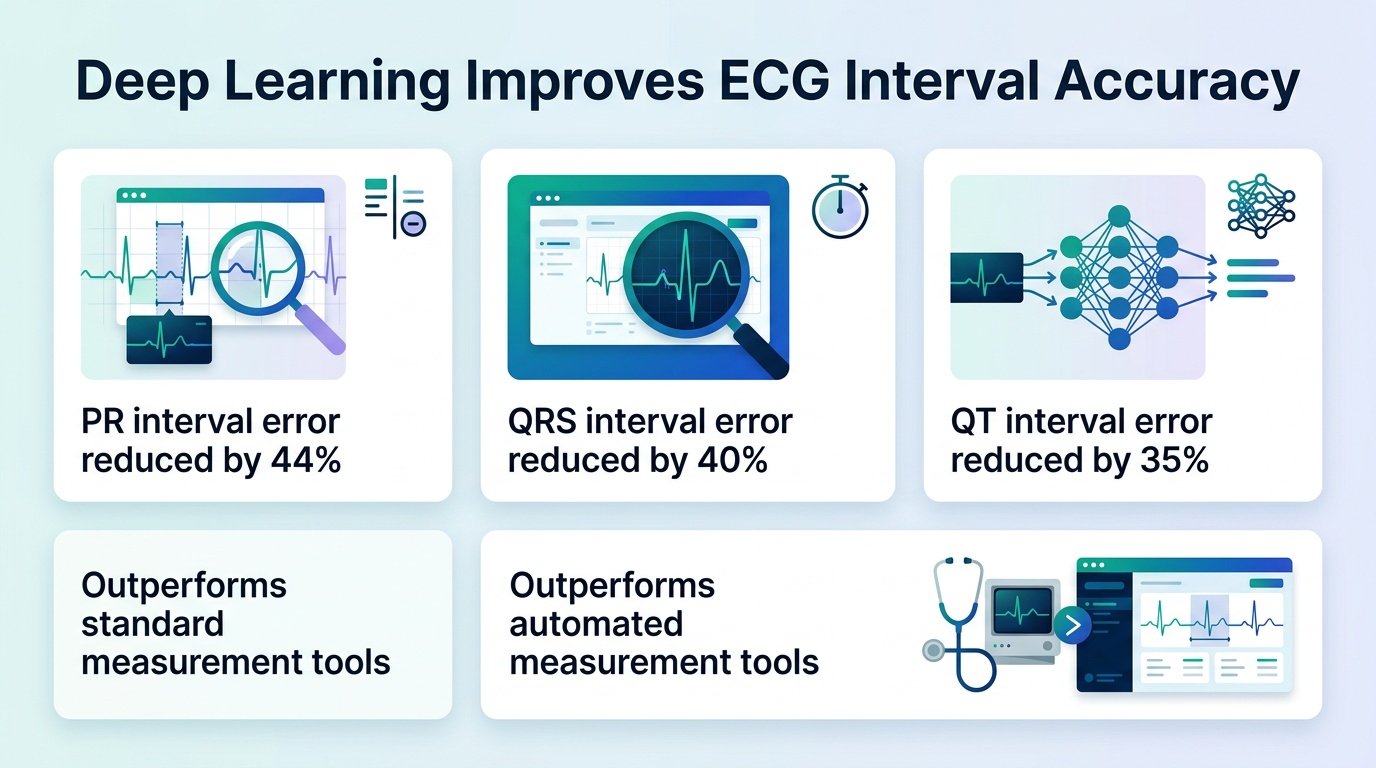
Standard automated ECG software often misses critical cardiac warning signs, but a new deep learning model trained on UK Biobank data proves we can do much better.
How much can we trust the automated ECG readings generated in clinics every day? For decades, doctors have relied on proprietary software built into ECG machines to flag hidden heart risks. Yet these legacy algorithms often rely on small, outdated datasets, leaving a massive margin of error that can miss patients on the brink of cardiovascular crisis.
This new study challenges the status quo of clinical cardiac screening. It proves that legacy commercial tools are failing to capture the true prognostic power of ECG intervals. By replacing old signal-processing methods with deep learning, we can dramatically improve how we predict major heart events.
Researchers built a reference dataset using 11,330 lead-level annotations from 12-lead ECGs across 1,030 randomly selected UK Biobank participants. They trained a 1D convolutional neural network to segment ECG waveforms and estimate PR, QRS, and QT intervals. The model’s performance was tested against expert annotations, UKB CardioSoft measurements, an open-source signal-processing toolbox, and a wavelet-based method. The experts themselves showed high agreement, with an intraclass correlation coefficient ranging from 0.81 to 0.97.
Superior Accuracy and Predictive Power
The deep learning model outperformed all traditional methods across the board. The key results from the held-out test set highlight this precision:
- Achieved mean absolute errors of just 7.7 ms for PR, 7.5 ms for QRS, and 4.9 ms for QT intervals.
- Confirmed over 80% validity for most interval measurements during a review of distributional outliers.
- Identified prolonged QTc intervals that associated strongly with incident major adverse cardiovascular events.
The difference in predictive power is stark. Among 46,749 participants with a median follow-up of 4 years, prolonged QTc derived by the deep learning model showed a hazard ratio of 2.9 (95% CI 2.1 – 4.0) for incident major adverse cardiovascular events (MACE). Meanwhile, wavelet-based measurements managed a hazard ratio of only 1.7 (95% CI 1.4 – 2.0), and the commercial CardioSoft software fell flat at 1.1 (95% CI 0.9 – 1.4).
That disconnect is the real story.
If a standard clinical tool has a hazard ratio confidence interval that crosses 1.0, it is essentially useless for predicting risk in these patients. This study suggests that the medical community has been relying on suboptimal software that dilutes the clinical value of the ECG. Transitioning to deep learning models could prevent thousands of missed diagnoses.
Real-World Clinical Limitations
We must remain realistic about the hurdles. While the model showed high validity, it was trained and tested on the UK Biobank, a cohort known to be healthier and less diverse than the general public. How this model performs in emergency departments or on patients with severe, complex arrhythmias remains an open question.
Read the full study in medRxiv.