By translating messy medical jargon into mathematical vectors, a new tool could finally fix how language models understand patient charts.
Large language models can pass medical licensing exams, but they still struggle to read a basic hospital chart. Why? Because electronic health records are written in a fragmented alphabet of competing clinical codes.
This disconnect is the real bottleneck in digital health. ClinVec challenges the current trend of throwing massive, ungrounded models at clinical tasks. It suggests that raw computing power cannot replace structured clinical guardrails.
Mapping the medical alphabet
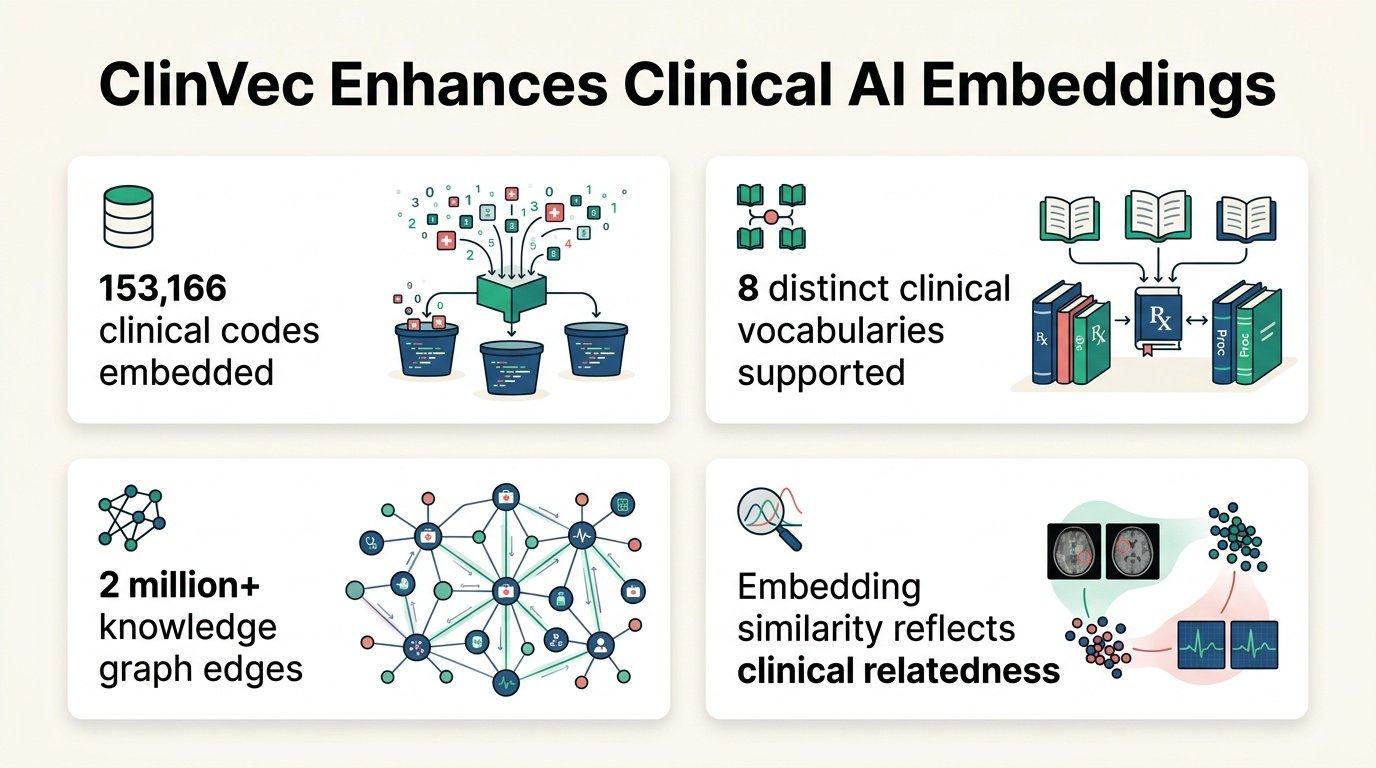
The system maps 153,166 clinical codes across 8 different vocabularies. It anchors these codes to ClinGraph, a massive medical knowledge graph containing more than 2,000,000 relational edges.
This unified map allows the AI to recognize when different codes point to the same underlying biological reality. It prevents the system from treating a billing code for diabetes and a lab result for high blood sugar as entirely unrelated concepts.
To prove these mathematical maps match real medicine, researchers tested them against 3,767 clinical term pairs across 11 disease areas. An independent panel of clinicians confirmed that the AI’s mathematical proximity aligned with actual clinical relationships.
Why structured knowledge wins
This approach builds on a growing consensus that raw electronic health record data is too messy for standard machine learning. Earlier frameworks like Adaptive Integration of Categorical and Multi-relational Ontologies attempted to bridge this gap by mixing ontologies with patient data. Similarly, researchers have used TAKECare to fuse temporal patient histories with structured medical knowledge. ClinVec scales this philosophy up, offering a ready-to-use repository that any developer can plug into their models.
The researchers demonstrated the utility of this shared representation across several key areas:
- Injecting clinical knowledge into large language models to improve medical question answering.
- Enabling unsupervised patient stratification to group similar cases without manual labeling.
- Improving clinical risk prediction by linking disparate data points in a patient’s history.
The limits of mapping
But a map is only as good as its terrain. ClinVec is restricted to the eight vocabularies it currently supports. If a rare disease or a novel treatment is poorly represented in those standard systems, the AI will still struggle to map it accurately.
Furthermore, clinical practice changes faster than official medical vocabularies. Because ClinVec relies on static clinical relationships, it may miss emerging real-world patterns that have not yet been codified into formal medical graphs.
Even with these limits, the tool shifts the focus of clinical AI. It proves that the future of safe medical AI lies in grounding models in established clinical reality, not just predicting the next word.
Read the full study in npj Digital Medicine.