
A massive federal cash injection aims to turn fragmented provincial hospital records into a unified engine for clinical artificial intelligence.
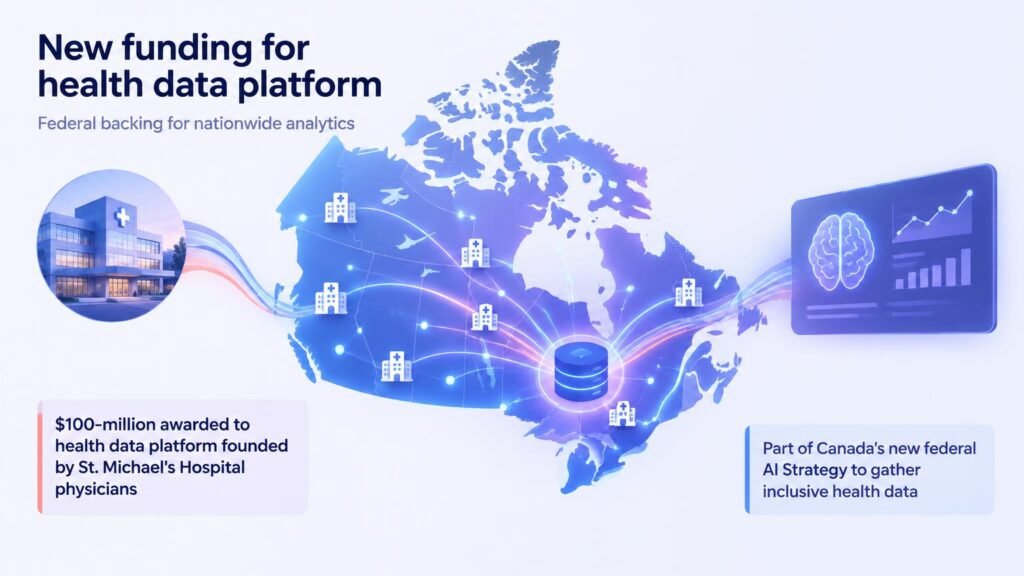
Canada is investing $100 million to scale VITAL, a data-sharing platform founded by physicians at St. Michael’s Hospital, from its current 160-hospital footprint into five additional provinces. The goal is to build a standardized, national database of de-identified clinical records to train predictive algorithms for critical conditions like sepsis.
But cash alone cannot buy interoperability. The expansion faces a fragmented provincial landscape where data standards and privacy regulations vary wildly by border.
The Integration Bottleneck
VITAL, which grew out of Ontario’s GEMINI project, has proven it can pool data across regional networks in Ontario, Alberta, and Quebec. Scaling nationwide, however, means confronting legacy electronic health record systems that do not talk to one another.
For clinicians, the promise of real-time clinical decision support is still years away. The immediate workload will not involve using AI, but rather the tedious, manual work of data cleaning and standardization across newly joined hospitals.
The Privacy Trade-off
To train models that actually save lives, researchers need deep, continuous patient data. Yet VITAL must navigate strict data sovereignty laws and rising public skepticism over health data privacy.
If the platform de-identifies data too aggressively to satisfy regulators, the resulting datasets may lose the clinical nuance required to build highly accurate predictive models. If the security measures fail, the entire national strategy risks collapse.
The true test of this $100-million bet is not how much data Canada can collect, but whether it can safely harmonize that data across provincial silos without diluting its clinical utility.