

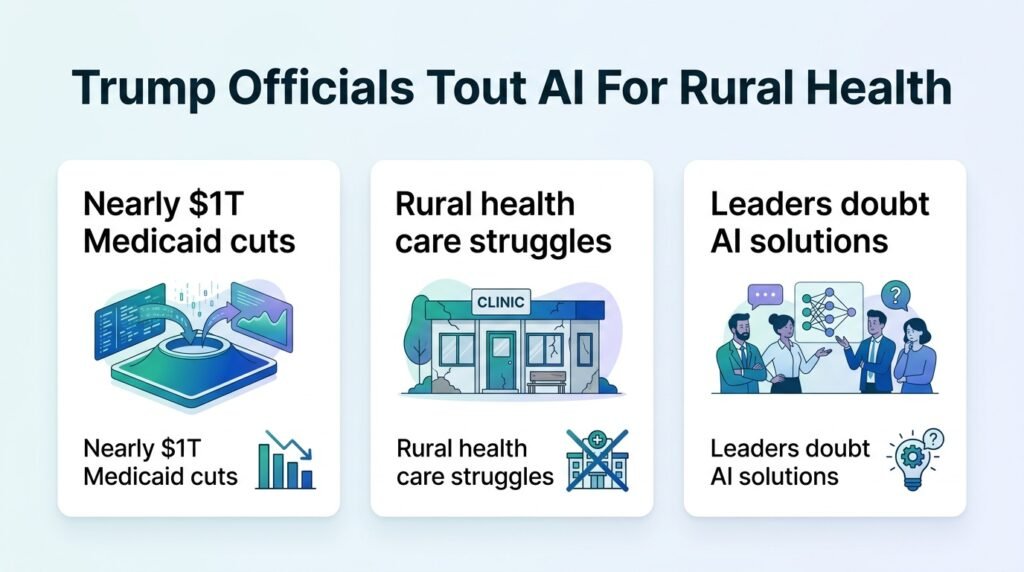
The federal government is pitching artificial intelligence as the cure for rural healthcare, but a massive budget shortfall suggests otherwise.
The math behind the latest rural healthcare strategy does not add up. Federal officials are promoting virtual avatars and “AI nurses” to solve severe staffing shortages. Yet this digital push coincides with a projected $1 trillion in Medicaid cuts over the next decade under new tax legislation.
Can software truly replace physical infrastructure? Rural health executives do not think so.
The Digital Band-Aid
Proponents of the $50 billion Rural Health Transformation Program argue that virtual assistants can bridge the gap for struggling clinics. They envision AI managing routine patient intake and basic diagnostics. But a virtual avatar cannot perform surgery, set a broken bone, or manage an emergency room.
Rural hospitals are already operating on razor-thin margins. Over the past decade, hundreds of facilities have closed, forcing patients to travel hours for basic care. Stripping $1 trillion from Medicaid will inevitably accelerate these closures, regardless of how many virtual assistants are deployed. Replacing human staff with algorithms looks less like innovation and more like a forced retreat.
The Denial Machine
There is also a trust deficit. Patients and providers already watch private insurers use AI to automate claim denials at scale. Introducing more unregulated algorithms into cash-strapped clinics could worsen this trend.
Without strict oversight, rural patients risk becoming test subjects for unproven diagnostic tools. When clinical algorithms make mistakes, isolated communities will pay the price. AI cannot fund a hospital, and it cannot replace a doctor.