Drug discovery is no longer just a biology problem; it is a massive infrastructure war.
The Compute Arms Race
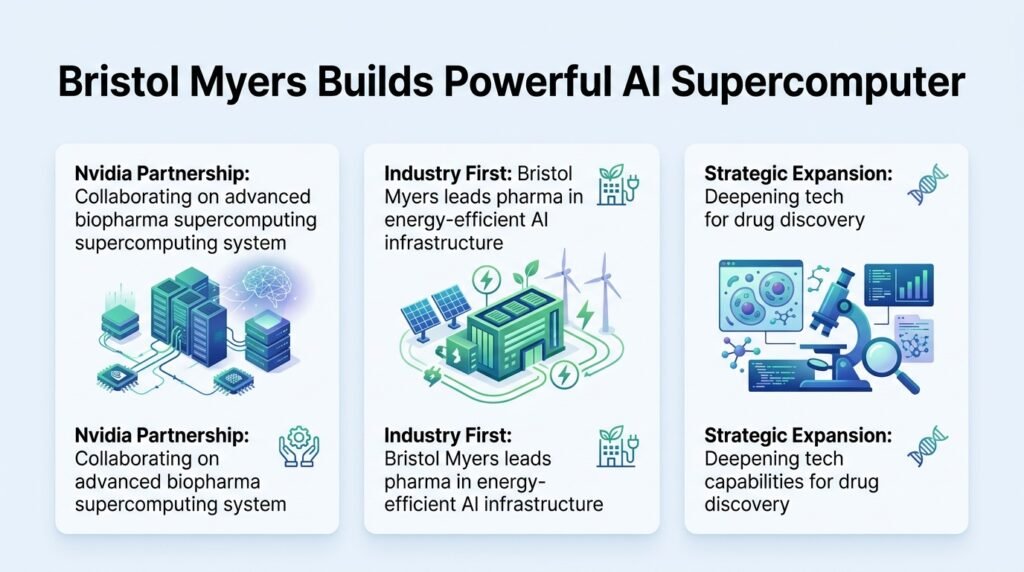
Bristol Myers Squibb is building what it claims will be the most advanced AI supercomputer in the biopharma industry. By partnering with Nvidia to deploy next-generation Vera Rubin architecture by January 2027, the drugmaker is signaling a major shift in how medicines are designed.
This is not just a routine IT upgrade. The new system will provide up to 15 times the capacity of the company’s previous setup. That older setup already cut computing costs by 55 percent while speeding up oncology research and clinical trial data analysis.
But this move highlights a broader tension. Big Pharma is locked in a high-stakes infrastructure war. Competitors like Eli Lilly and Roche are also racing to build their own large-scale, Nvidia-powered systems to expedite drug discovery.
The Data Bottleneck
For years, pharma companies relied on third-party cloud providers. Now, they are building proprietary, on-premise fortresses of compute. This shift suggests that proprietary AI infrastructure is now viewed as a core competitive advantage that cannot be outsourced.
Yet, the real challenge is not acquiring silicon. It is managing the biological data that feeds it.
Supercomputers require pristine, structured datasets to yield actual therapeutic breakthroughs. Without high-quality biological inputs, massive compute power just generates expensive noise.
The industry must now prove that these multi-million-dollar investments can deliver actual clinical candidates, not just faster simulations. The winner of this race will not be the company with the biggest supercomputer. It will be the one that successfully integrates these machines into daily laboratory workflows.