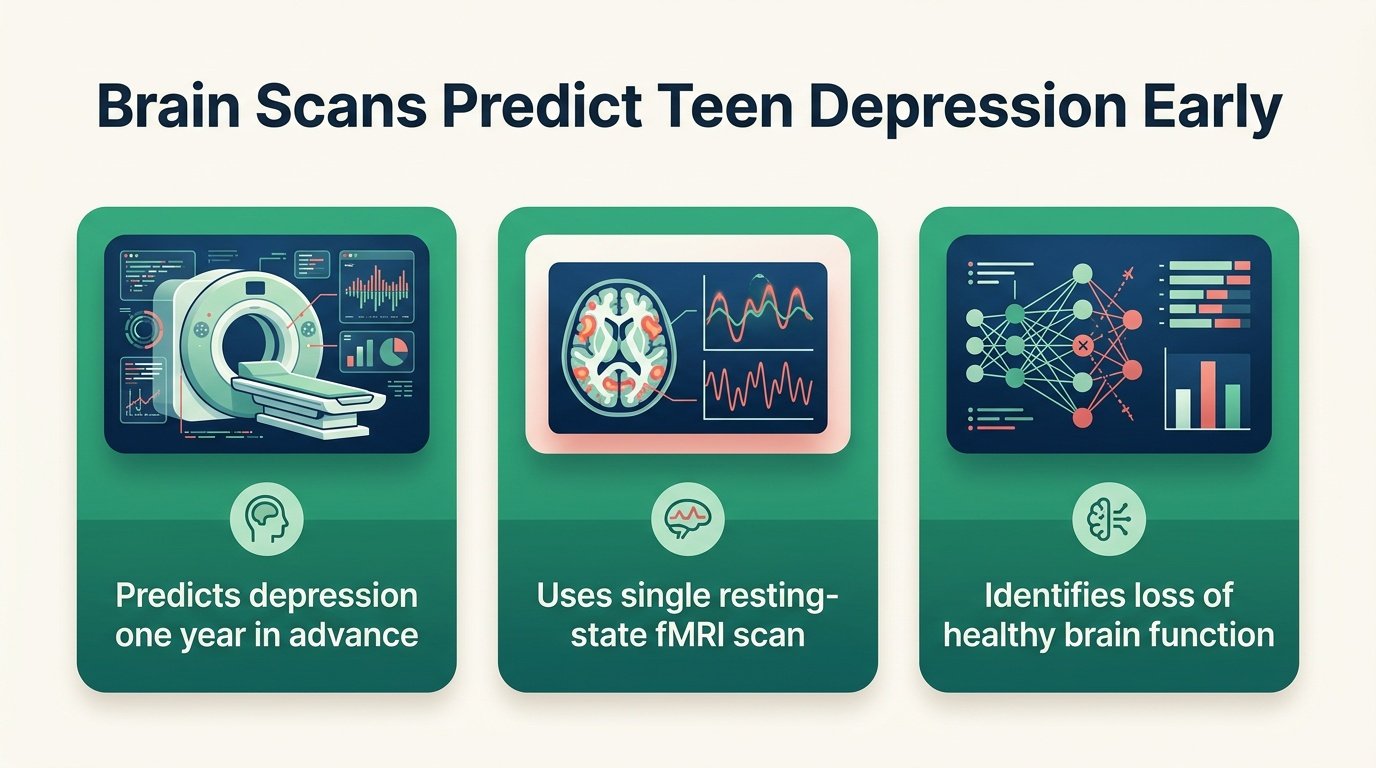
A new computational model uses a single brain scan to predict adolescent anxiety and depression before symptoms fully emerge.
Why do we wait for teenagers to spiral before we treat their mental health? Today, clinical psychiatry is almost entirely reactive. We wait for the crisis, then try to pick up the pieces.
A new preprint challenges this status quo by finding a neural “canary in the coal mine.” By modeling brain dynamics instead of just mapping static connections, researchers bypassed a major limitation in psychiatric neuroimaging.
The study analyzed 150 adolescents from the Human Connectome Project Boston Adolescent Neuroimaging of Depression and Anxiety (HCP BANDA) cohort. Instead of relying on raw functional connectivity, the team fitted a whole-brain generative model to each participant’s resting-state fMRI. This computational approach captures underlying brain dynamics that standard covariance-based features miss.
The model successfully predicted depression and anxiety symptoms one year later in held-out participants with a correlation of r = 0.60. This performance sits substantially above the usual effect-size ceiling for functional connectivity in this dataset.
Moving beyond static maps
For years, neuroimaging struggled with low predictive power, often failing to replicate across larger cohorts. Earlier efforts, like those analyzing multi-level predictors in the ABCD study, showed how difficult it is to find reliable neural markers for depression. This new model succeeds because it stops treating the brain as a static map.
Instead, it simulates how information flows through key regions. The predictive power is concentrated in the precuneus, ventromedial prefrontal cortex, and anterior cingulate cortex. These areas are already known to govern self-referential thought and emotional regulation.
Why this matters
This is not just another correlation. If a single baseline scan can flag a vulnerable teenager a year before clinical diagnosis, we can shift from crisis management to preventative care. We could screen high-risk youth and intervene before debilitating symptoms set in.
However, we must remain cautious about clinical deployment. The sample size of 150 participants is small, and the model still requires external validation on more diverse populations. We have seen similar predictive models for youth behavior, such as those predicting disruptive behavior disorders, struggle when applied to real-world clinical settings.
Key findings from the model
- Achieved a predictive accuracy of r = 0.60 for symptoms one year in the future.
- Identified the precuneus and anterior cingulate cortex as primary drivers of prediction.
- Linked the same neural signature to cognitive efficiency in healthy participants.
If these findings hold up in larger trials, they could change how we allocate scarce mental health resources.
Read the full preprint on medRxiv.