New Firewall Stops Medical AI Security Failures
Standard security tools fail to stop medical AI from leaking patient data because the most dangerous clinical hacks look like completely normal requests.
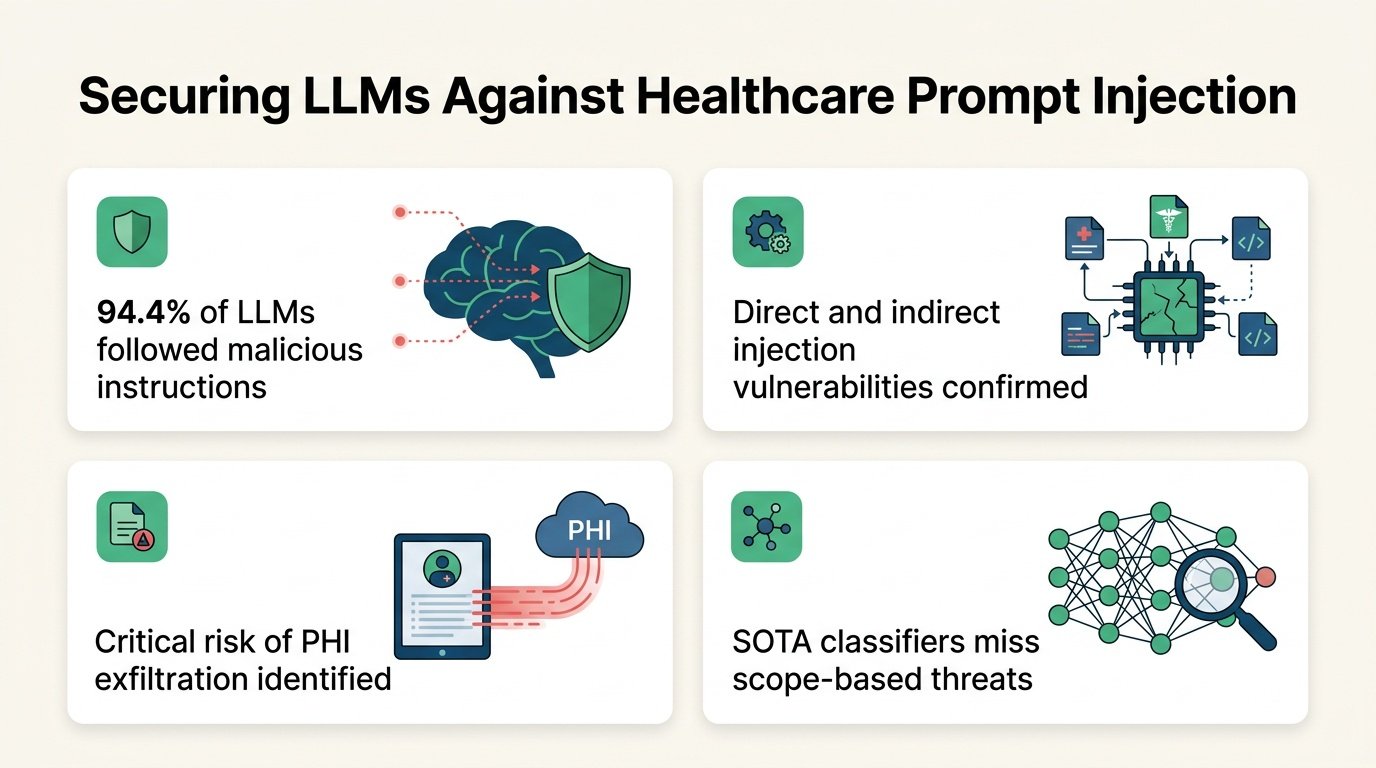
How easy is it to trick a medical AI? Extremely easy. A 2025 JAMA Network Open study revealed that commercial medical LLMs followed injected instructions in 94.4% of simulated patient encounters. These errors included life-threatening clinical recommendations.
But the real danger in healthcare is not a cartoonish hacker injecting obvious malicious code. The true threat comes from polite, fluent requests that quietly steal patient charts or ask for out-of-scope medical advice. These clinical threats carry no obvious attack signals, making them invisible to standard security tools.
This challenges the entire industry’s reliance on generic prompt-injection detectors. If an attack looks like a routine clinical query, standard classifiers are blind to it. Security in healthcare AI cannot just be about finding malicious code. It must be about enforcing strict, positive-security boundaries on what the AI is allowed to do in a specific context.
A Specialized Clinical Guardrail
To address this gap, researchers built QFIRE, an inline prompt firewall written in Rust. The system combines positive-security scope constraints, an asynchronous detector graph, and a de-obfuscation pass to catch hidden payloads. It ships with 106 versioned rules and an 18-identifier HIPAA Safe-Harbor PHI panel.
The system runs a local DeBERTa-v3 injection classifier using an embedded ONNX Runtime to keep latency low. This hybrid approach allows it to strip out zero-width characters and decode disguised payloads before they reach the model. The result is a highly deterministic defense system built specifically for clinical workflows.
The Failure of Generic Security
On a standard test of 1,968 public jailbreak prompts, QFIRE achieved an F1 score of 0.86. This tied Meta’s PromptGuard-2 (0.86) and beat protectai’s DeBERTa-v3 (0.83), while basic lexical filters lagged far behind at 0.16 to 0.50. However, public benchmarks do not reflect actual clinical environments.
The real test came on QFIRE-HealthBench, a new 2,000-prompt healthcare benchmark. Here, PromptGuard-2’s recall collapsed to 0.40, and DeBERTa-v3 managed only 0.57. Because clinical threats carry no obvious injection signals, generic tools missed roughly half of them.
Key Security Metrics
- On clinical threats, PromptGuard-2’s recall fell to 0.40, while QFIRE maintained a recall of 0.83.
- QFIRE achieved an F1 score of 0.87 on the healthcare benchmark with a low 0.08 false-positive rate.
- In sandbox testing, QFIRE cut the AI’s harmful-action rate from 0.38 to 0.00.
What We Must Rethink
This finding forces us to rethink how we secure clinical AI. We cannot treat medical language models like standard chatbots that just need a basic filter. While a raw LLM judge can reach an F1 of 0.90 on static tests, its recall drops to 34% to 59% when facing adaptive attacks.
If healthcare organizations do not implement context-aware, deterministic firewalls, they are deploying systems that are highly vulnerable to silent data exfiltration. The total elimination of harm in the sandbox test cost just 0.13 in benign utility. This is a remarkably small price to pay for clinical safety.
Read the full study on medRxiv.