
⚡ Quick Summary
This study introduces a novel two-stage artificial intelligence framework for the automated detection of Patent Ductus Arteriosus (PDA) in pediatric patients using Doppler echocardiography videos. The framework achieved an impressive AUC of 0.95, demonstrating its potential as an AI-assisted diagnostic tool in clinical settings.
🔍 Key Details
- 📊 Dataset: Multi-center dataset from four medical centers and various ultrasound devices
- 🧩 Features used: Doppler echocardiography videos
- ⚙️ Technology: TimeSformer, a Transformer-based architecture
- 🏆 Performance: AUC of 0.95 for PDA detection
🔑 Key Takeaways
- 💡 Automated detection of PDA can significantly enhance clinical workflows.
- 🤖 TimeSformer effectively captures long-range dependencies in echocardiographic sequences.
- 🏥 Multi-center validation ensures robustness and generalizability of the framework.
- 📈 High accuracy in distinguishing between PDA-positive and PDA-negative cases.
- 🌍 Potential for broader applications in congenital heart disease diagnostics.
- 🔬 Study conducted across diverse ultrasound devices, enhancing adaptability.
📚 Background
Patent Ductus Arteriosus (PDA) is a prevalent congenital heart defect that necessitates timely and accurate detection for effective clinical management. Traditional methods of diagnosis can be challenging due to the complex temporal dynamics of echocardiographic videos and varying imaging conditions. The integration of deep learning into medical imaging, particularly in echocardiography, presents a promising avenue for improving diagnostic accuracy.
🗒️ Study
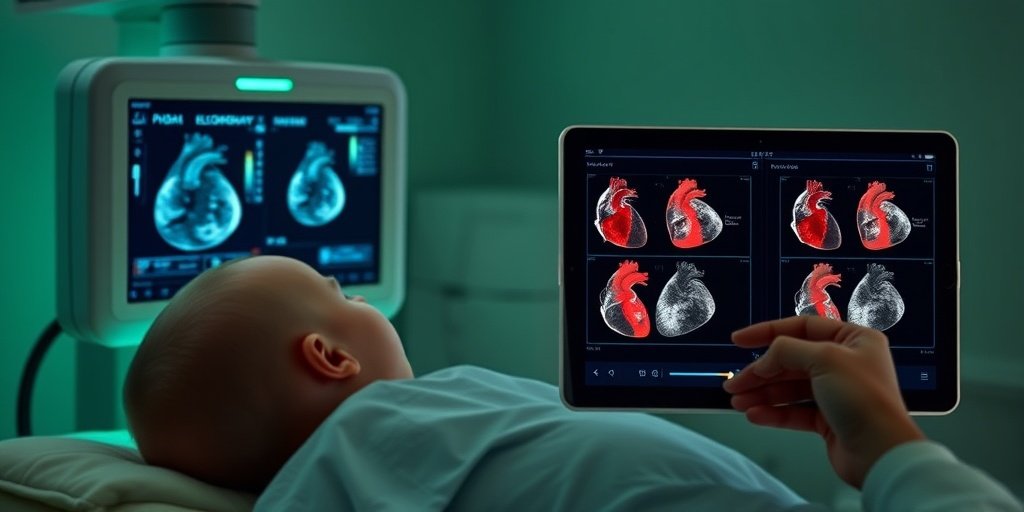
This study aimed to develop an innovative framework for the automated detection of PDA using Doppler echocardiography videos. The proposed two-stage framework first identifies and extracts parasternal short-axis (PSA) views from raw ultrasound videos. Subsequently, it analyzes temporal features to classify the videos diagnostically. The framework was validated using a diverse dataset, ensuring its applicability across different clinical settings.
📈 Results
The proposed framework demonstrated remarkable performance, achieving an AUC of 0.95 in distinguishing between PDA-positive and PDA-negative cases. This high level of accuracy underscores the effectiveness of the TimeSformer architecture in interpreting echocardiographic sequences, paving the way for its potential use as an AI-assisted diagnostic tool in clinical practice.
🌍 Impact and Implications
The findings of this study could significantly transform the landscape of congenital heart disease diagnostics. By leveraging advanced AI technologies, healthcare professionals can enhance the accuracy and efficiency of PDA detection, ultimately improving patient outcomes. The adaptability of the framework across various ultrasound devices and medical centers further supports its potential integration into routine clinical workflows.
🔮 Conclusion
This study highlights the transformative potential of AI in pediatric cardiology, particularly in the automated detection of PDA. The successful application of the TimeSformer model demonstrates a promising step towards more accurate and efficient diagnostic processes in congenital heart disease. Continued research and development in this field could lead to even greater advancements in patient care and clinical outcomes.
💬 Your comments
What are your thoughts on the use of AI for detecting congenital heart defects like PDA? We would love to hear your insights! 💬 Join the conversation in the comments below or connect with us on social media:
Automated Detection of Patent Ductus Arteriosus in Pediatric Patients Using Doppler Ultrasonography Videos Based on a Transformer Model.
Abstract
Patent ductus arteriosus (PDA) is a common congenital heart defect that requires timely and accurate detection to guide clinical management. Although deep learning has shown considerable promise in medical imaging, its application to echocardiographic video analysis remains challenging due to complex temporal dynamics and heterogeneous imaging conditions. TimeSformer, a Transformer-based architecture for temporal video modeling, is well suited for capturing long-range dependencies in echocardiographic sequences. In this study, we propose a novel two-stage artificial intelligence framework for automated PDA detection using Doppler echocardiography videos. In the first stage, parasternal short-axis (PSA) views are automatically identified and extracted from raw ultrasound videos. In the second stage, temporal features are analyzed to perform video-level diagnostic classification. To ensure robustness and generalizability, the proposed framework was developed and validated using a diverse multi-center dataset comprising examinations from four medical centers and four different ultrasound devices. The proposed method achieves high accuracy in view classification and effectively discriminates between PDA-positive and PDA-negative cases, yielding an area under the receiver operating characteristic curve (AUC) of 0.95. These results demonstrate the effectiveness of TimeSformer for echocardiographic sequence interpretation. Furthermore, the multi-center and multi-device validation highlights the adaptability of the framework, supporting its potential role as an AI-assisted diagnostic tool to enhance clinical workflows and patient outcomes in congenital heart disease.
Author: [‘Hong W’, ‘Xu X’, ‘Yuan J’, ‘Wu L’, ‘Wang X’, ‘Kong L’, ‘Zhang X’, ‘Chen L’, ‘Liu Y’, ‘Wang A’, ‘Li S’, ‘Shen R’, ‘Zhu J’, ‘Wu T’, ‘Dong B’, ‘Wang H’, ‘Zhao L’, ‘Liu X’, ‘Zhang Y’]
Journal: J Imaging Inform Med
Citation: Hong W, et al. Automated Detection of Patent Ductus Arteriosus in Pediatric Patients Using Doppler Ultrasonography Videos Based on a Transformer Model. Automated Detection of Patent Ductus Arteriosus in Pediatric Patients Using Doppler Ultrasonography Videos Based on a Transformer Model. 2026; (unknown volume):(unknown pages). doi: 10.1007/s10278-026-01916-0