AI predicts cancer survival using entire treatment timelines
By tracking entire patient histories instead of clinical snapshots, a new AI model outperforms traditional cancer staging systems across three countries.
Why does oncology still rely on static snapshots to predict survival when a patient’s journey is a chaotic, moving target? Traditional staging systems freeze a single moment in time. This approach ignores the messy, real-time reality of daily clinical updates, drug changes, and sudden complications.
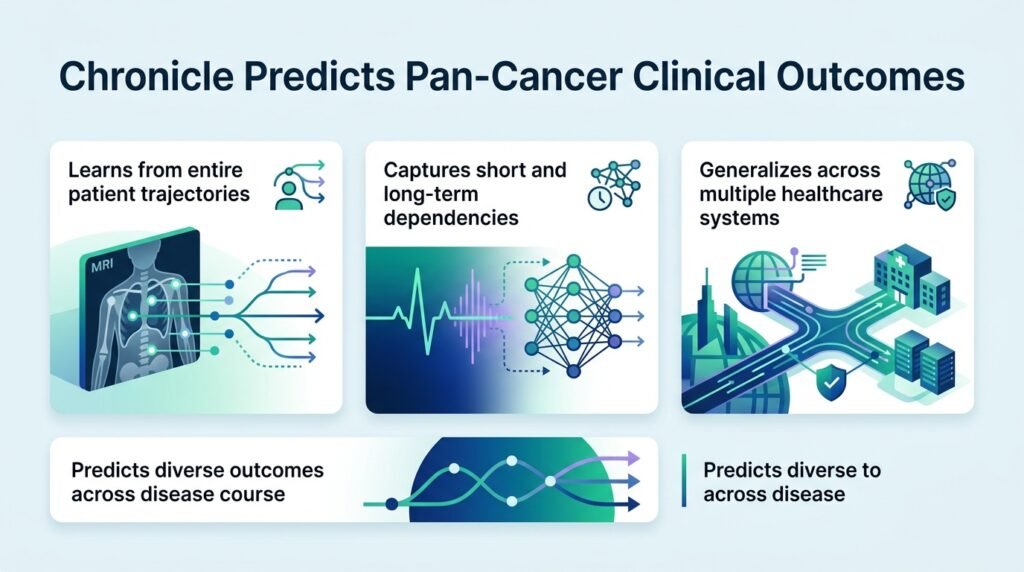
A new model called Chronicle challenges this status quo by treating the electronic health record as a continuous timeline. This shifts the focus from what a patient has to how they are evolving. It suggests that clinical prediction must move away from rigid, one-time staging toward dynamic, rolling risk assessments.
How the model works
Researchers built Chronicle using **53.7 million** longitudinal data points from **51,711** patients across **67** cancer types. Instead of cleaning up irregular data or guessing missing values, the transformer architecture processes raw, messy timelines. This builds on previous efforts to tokenize longitudinal health records, such as Multi-dimensional patient acuity estimation, which proved that sequential data holds more predictive power than isolated clinical events.
The results show a clear leap in accuracy over traditional methods. Chronicle achieved an overall survival prediction C-index of **0.84**, comfortably beating standard cross-sectional models which scored between **0.76** and **0.79**. It also outperformed the established TNM staging system, which has been the global benchmark for cancer prognosis for decades.
Key performance metrics
- Overall survival prediction reached a C-index of 0.84.
- Adverse events and transfusion needs were predicted with an AUC of 0.80 to 0.92.
- The model successfully evaluated risk across 69,341 external patients without initial retraining.
The real-world implications
This is not just about higher accuracy numbers. It is about clinical utility. Chronicle tracks the “half-life” of medical data, proving that therapy details lose predictive relevance within weeks, while baseline characteristics remain useful for nearly a year. This temporal awareness prevents doctors from relying on outdated clinical events to make current decisions.
Furthermore, the model proved its adaptability. When tested on **69,341** patients across Germany, Switzerland, and the United States, it generalized across different healthcare systems without retraining. This addresses a major hurdle in clinical AI, where models trained in one hospital often fail in another, a challenge also explored in generative EHR research like TransformEHR.
However, we must remain cautious. Chronicle is currently described in a preprint, meaning it has not yet undergone full peer review. While it adapts well, local fine-tuning was still required to achieve peak performance in different countries. Hospitals must also possess the digital infrastructure to feed continuous, real-time data into the model, which remains a luxury in many healthcare systems.
Read the full preprint on medRxiv.