

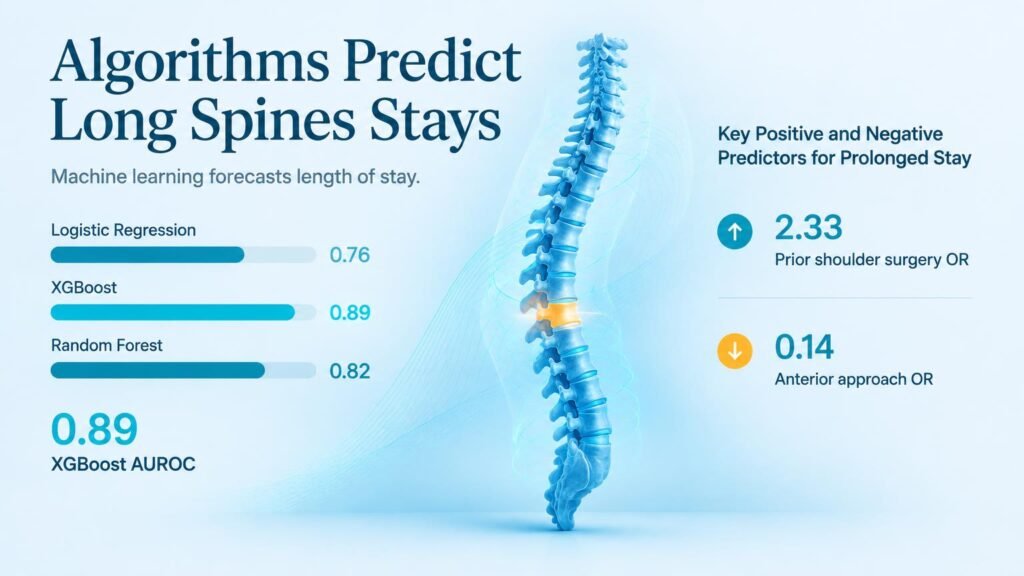
Preoperative algorithms can identify which spine surgery patients will face prolonged hospital stays before they enter the operating room.
Spine surgeons often struggle to predict which patients will occupy hospital beds long after elective procedures. A new multicenter registry study demonstrates that routine preoperative data alone can flag extended stays with high accuracy, challenging the practice of waiting until after surgery to initiate complex discharge planning.
That shift moves recovery planning from reactive troubleshooting to upfront clinical strategy.
Predicting bed utilization is crucial for hospital efficiency and patient outcomes. Extended inpatient stays after cervical spondylotic myelopathy surgery raise complication risks, increase financial overhead, and strain institutional resources. By surfacing high-risk profiles before admission, clinical teams can target physical therapy resources and discharge pathways far earlier in the care continuum.
Researchers analyzed prospectively collected registry data from 14 high-volume Spine CORe sites within the Quality Outcomes Database. Out of 1,141 adult patients who underwent elective surgery for cervical spondylotic myelopathy, 1,020 patients met all criteria and were included in the final cohort. The primary target was predicting a prolonged length of stay, defined strictly as ≥ 3 days, using preoperative clinical, demographic, and surgical variables.
High accuracy from preoperative data
Machine learning models achieved high discrimination using only preoperative features. Logistic regression demonstrated a mean AUROC of 0.88 ± 0.02, matching performance from XGBoost at 0.89 ± 0.02 and random forest models at 0.89 ± 0.02. These figures align with earlier national research on machine learning for cervical spine surgery length of stay, proving that surgical complexity and baseline frailty create clear predictive patterns.
Regression analysis isolated several significant preoperative variables that alter the likelihood of an extended inpatient admission:
- Prior shoulder surgery: OR 2.33 (95% CI 2.16–2.51, p = 0.04)
- Greater total fused levels: OR 1.89 (95% CI 1.83–1.95, p < 0.001)
- Diabetes: OR 1.75 (95% CI 1.66–1.83, p = 0.049)
- Anterior surgical approach: OR 0.14 (95% CI 0.12–0.17, p < 0.001)
- Radicular motor deficit: OR 0.49 (95% CI 0.45–0.54, p = 0.030)
- Greater baseline modified Japanese Orthopaedic Association score: OR 0.87 (95% CI 0.86–0.88, p = 0.007)
Clinical interpretation and practical limits
The strong association between prior shoulder surgery and longer stays points to an overlooked subgroup. Patients with combined shoulder and cervical pathology often face compound rehabilitation barriers that delay early postoperative mobilization.
Conversely, patients undergoing anterior approach surgery or presenting with higher baseline functional scores showed significantly shorter stays. These findings complement broader work evaluating predictive models in elective spine surgery.
However, predictive accuracy in a registry model is not proof of improved clinical care. Retrospective validation on observational data cannot guarantee that flagging high-risk patients will reduce stays or lower complications in active practice. Health systems must test these algorithms in prospective workflow trials to determine whether early discharge planning actually improves clinical outcomes or merely shifts care burdens elsewhere.
Read the study in the Journal of Neurosurgery Spine.