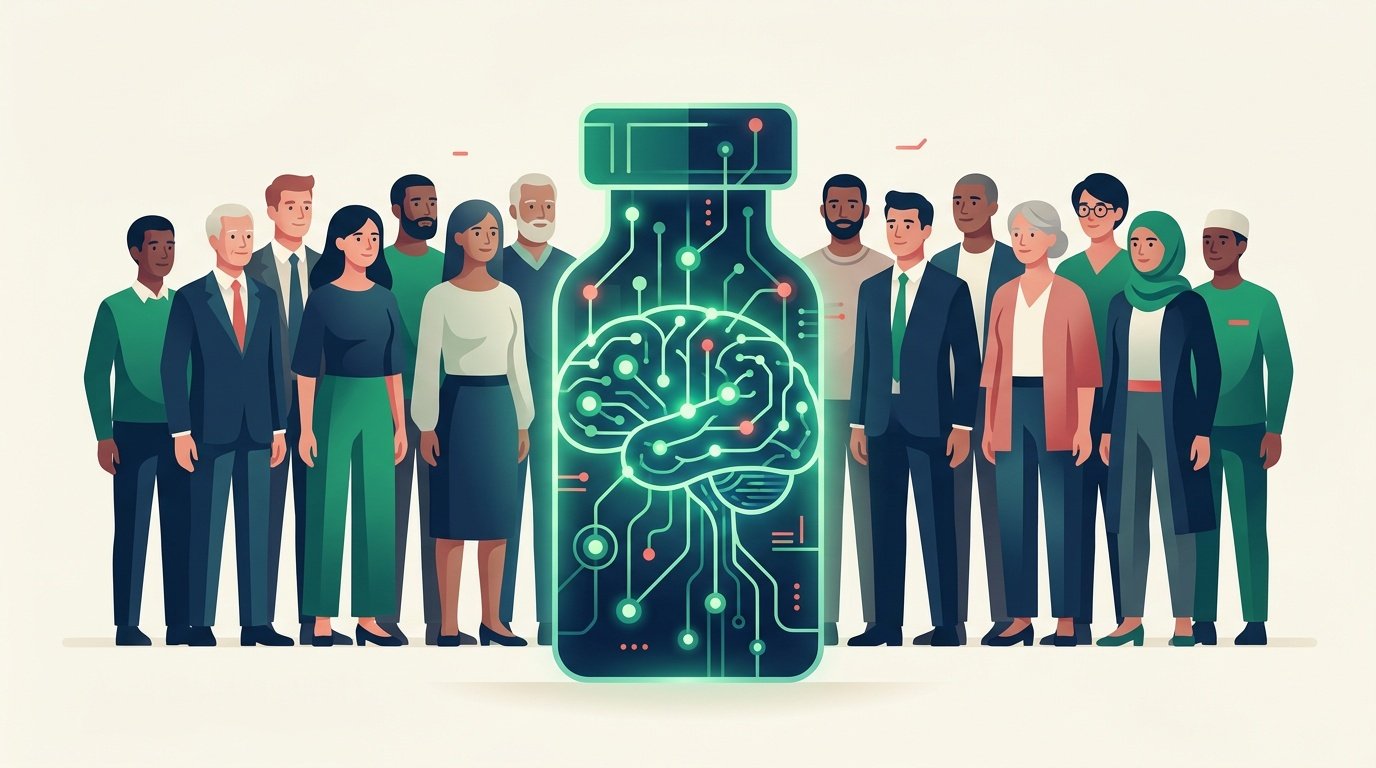
A new vaccine design platform aims to stop future pandemics before they start, but our own immunological history presents a stubborn roadblock.
The Predictability Problem
Vaccine design has historically been reactive. We wait for a virus to mutate, then scramble to update our shots. An AI-designed vaccine candidate attempts to flip this script by targeting “super-antigens” common to entire viral families.
In a Phase 1 trial of 39 healthy volunteers, the DNA-based vaccine proved safe when delivered via a needle-free jet injection. It successfully triggered immune responses against both SARS-CoV-2 and the original SARS virus. This is a vital proof of concept for predictive vaccinology.
But the biology of human history got in the way.
The Immunity Paradox
The trial revealed a critical bottleneck. The generated immune response was modest and did not scale up with higher doses.
Why? The researchers point to our own immunological memory. Because almost everyone now has pre-existing immunity from prior infections or standard vaccinations, our bodies may neutralize the vaccine vector before it can deliver its full payload.
This is the central paradox of future-proof vaccinology. The very immunity we built to survive the last pandemic might shield our bodies from the tools designed to prevent the next one.
Why This Matters
This trial proves we can computationally design antigens to target multiple viruses at once. The platform is already being adapted for influenza and Ebola. However, developers must solve the dosing and pre-existing immunity puzzle in upcoming Phase 2 trials before these broad-spectrum designs can offer reliable real-world protection.