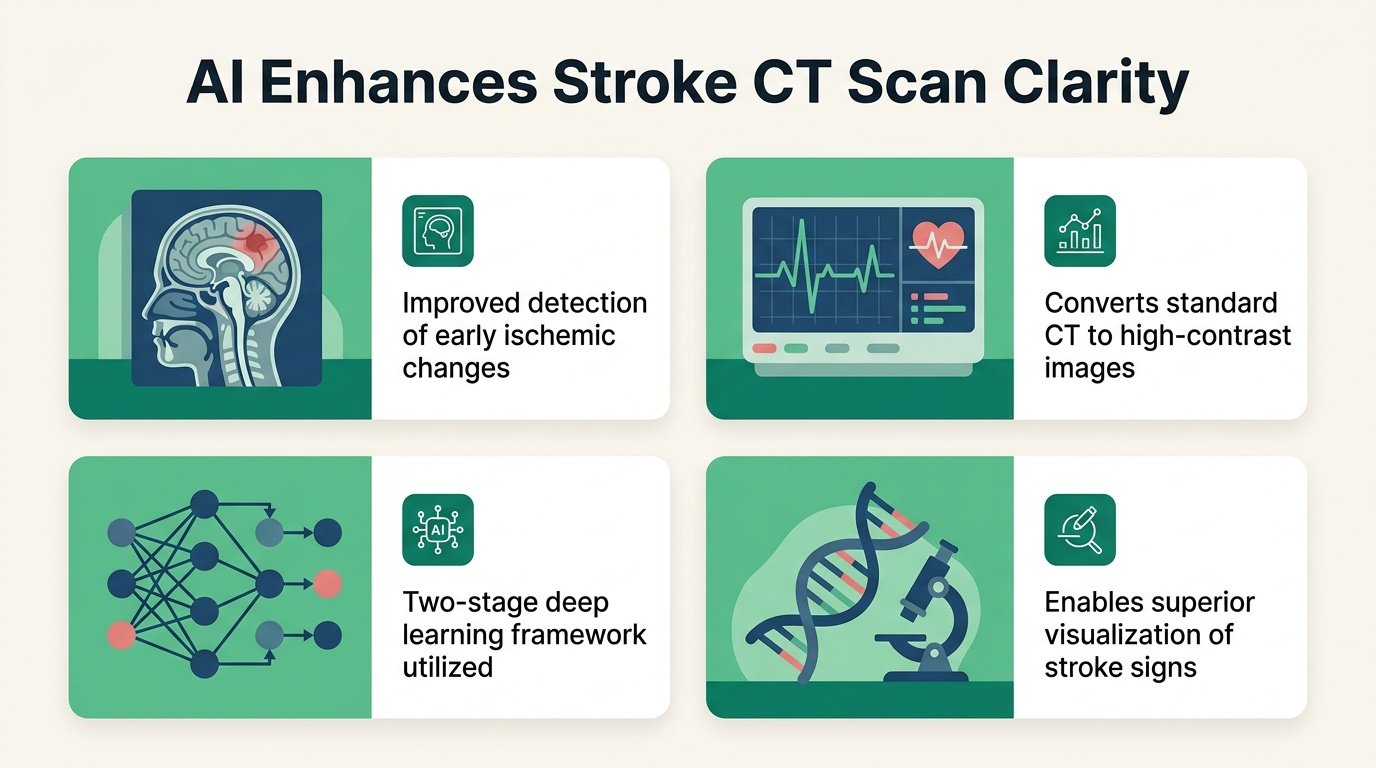
A new deep learning model turns cheap, blurry brain scans into high-contrast maps, helping doctors spot stroke damage faster and agree on treatment.
How do you treat a stroke when the clock is ticking but the brain scan is a blurry mess of gray? Standard non-contrast CT scans are fast and cheap, but they are notoriously difficult to read in the first critical hours of a brain injury. Doctors often disagree on what they see, which delays life-saving interventions.
This study suggests we do not need expensive new imaging hardware to solve this clinical bottleneck. Instead, we can use smart software to extract hidden clarity from the machines we already have.
Researchers evaluated a two-stage deep learning framework using data from 303 participants (mean age 67.2 ± 12.7 years; 187 male) who suffered large vessel occlusion strokes between 2020 and 2024 across four medical centers. At baseline, these patients had a mean Tmax-ASPECTS of 4.9 ± 2.7 and a median ischemic volume of 50.36 mL (IQR, 29.36–72.49 mL). The AI took their standard non-contrast CT scans and converted them into high-contrast thin-slice CT (HCCT) images.
Closing the agreement gap
The results show a massive jump in diagnostic consistency. When two neuroradiologists evaluated the standard scans, their agreement score was a mediocre 0.72. With the AI-assisted HCCT scans, that correlation surged to 0.94.
This software effectively removes the subjective guesswork that plagues early stroke triage. By aligning different readers to near-perfect agreement, the technology ensures that patient care does not depend on which radiologist happens to be on shift.
Key performance metrics from the trial include:
- The intra-class correlation coefficient (ICC) for HCCT-assisted ASPECTS was 0.85 (95% CI: 0.80 to 0.89), compared to 0.90 (95% CI: 0.87 to 0.93) for the Tmax-ASPECTS reference standard.
- Both readers showed a strong correlation of ischemic volumes between the HCCT-assisted group and Tmax (r = 0.83 for both; p < 0.001).
- An ASPECTS score of 6 or higher on the AI scans strongly predicted favorable patient outcomes (NRAD1: OR 2.87, 95% CI 1.97-5.21; NRAD2: OR 2.74, 95% CI 1.78-5.55).
Rethinking diagnostic hardware
This approach challenges the assumption that better diagnostics require buying newer, more expensive scanners. Upgrading existing clinical tools with software is highly practical. This shift is part of a broader movement detailed in Portable neuroimaging and AI: democratizing brain diagnostics, which highlights how digital tools can maximize legacy hospital hardware.
However, we must note the study’s limits. This was a retrospective analysis of patients already known to have severe large vessel occlusions. The model must still prove its worth in real-time, chaotic emergency rooms where patients present with a wider mix of milder symptoms.
Read the full study in the American Journal of Neuroradiology.