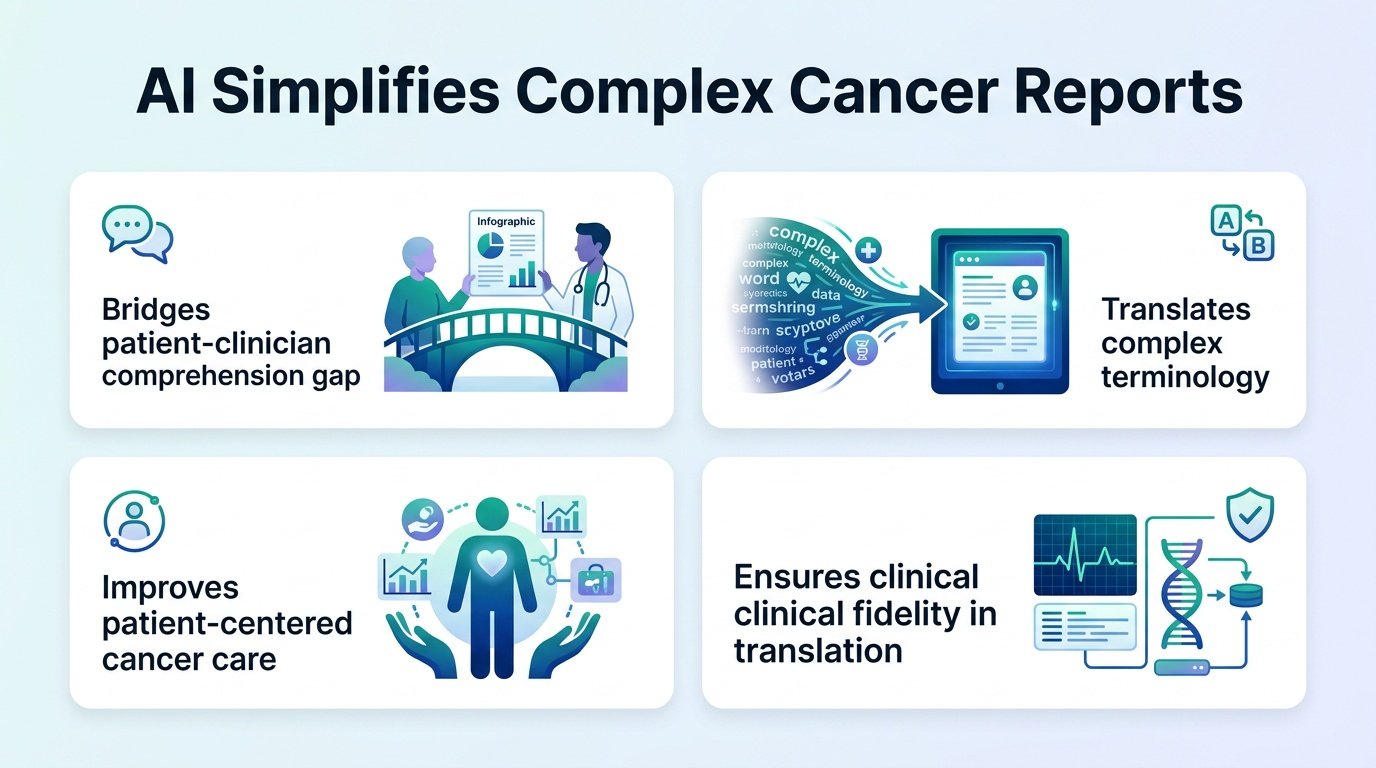
Automated translation of complex radiology scans can finally bypass the medical jargon barrier, but only if radiologists remain the ultimate gatekeepers.
A patient opens their online portal and sees “adenocarcinoma with suspected nodal involvement” on their scan. Panic sets in before the oncologist even has time to call. For years, the medical community has struggled to share clinical results without causing unnecessary psychological harm.
This new pipeline shows that AI can translate these terrifying documents into gentle, bilingual summaries. But the real lesson is that raw LLMs are too dangerous for direct patient use. We must build structured, doctor-validated pipelines rather than letting patients copy-paste their scans into public chatbots.
The translation pipeline
Researchers developed the Vernacular Language Converter (VLC) using a retrospective set of 100 colorectal cancer CT scans. They benchmarked five models, including GPT-4o, Gemini 2.5 Pro, Claude Opus, LLaMA-3.1-8B, and Phi-3.5-mini. Ultimately, Gemini 2.5 Pro anchored the system, translating reports into simplified English and Hindi.
This bilingual focus is a major leap forward. While previous research looked at simplifying reports in English, non-English speaking patients are often left entirely in the dark. By offering Hindi translations, this pipeline addresses a massive equity gap in global oncology.
What the data shows
A prospective validation of another 100 reports showed that the tool does not sacrifice clinical safety for simplicity. Two expert radiologists graded the outputs on a five-point scale.
The performance metrics highlight the precision of the pipeline:
- Achieved 100% core diagnostic completeness across all patients.
- Scored 4.77 out of 5 for clinical accuracy.
- Scored 4.78 for language clarity and 4.9 for readability and tone.
- Allowed 92% of the reports to be released to patients “as is” without manual edits.
- Boosted the Flesch Reading Ease score from a dense 49.2 to a highly readable 73.
These numbers prove that structured prompts can tame the hallucination tendencies of standard LLMs. We have seen similar success in other fields, such as using AI for simplifying dental radiology reports, but cancer care carries much higher emotional stakes.
The clinical catch
The high success rate is impressive, but the remaining 8% of reports that required human edits are where the danger lies. In oncology, a single mistranslated word can alter a patient’s understanding of their prognosis.
If an AI misinterprets a benign cyst as a recurrence, the psychological damage is done instantly. That is why the “as is” rate of 92% is both a triumph and a warning. It means radiologists must still review every tenth report to catch critical errors.
This tool should not be deployed as a direct-to-consumer app. It belongs embedded inside electronic health record systems where a clinician can click “approve” before the patient sees it. The goal is to save the doctor time, not to replace their oversight.
This analysis is based on a study published in Frontiers in Oncology.