 Yusuf Yesil, MD, MIS
Hospitals are bleeding cash to keep beds staffed. They spend an estimated $97 billion annually on temporary contract workers just to stay afloat. Yet, traditional trade schools cannot graduate medical assistants or technicians fast enough to fill a projected shortage of 3.2 million workers.
The bottleneck is not a lack of willing students. It is an outdated, manual education system bound by physical enrollment caps.
The Speed Premium
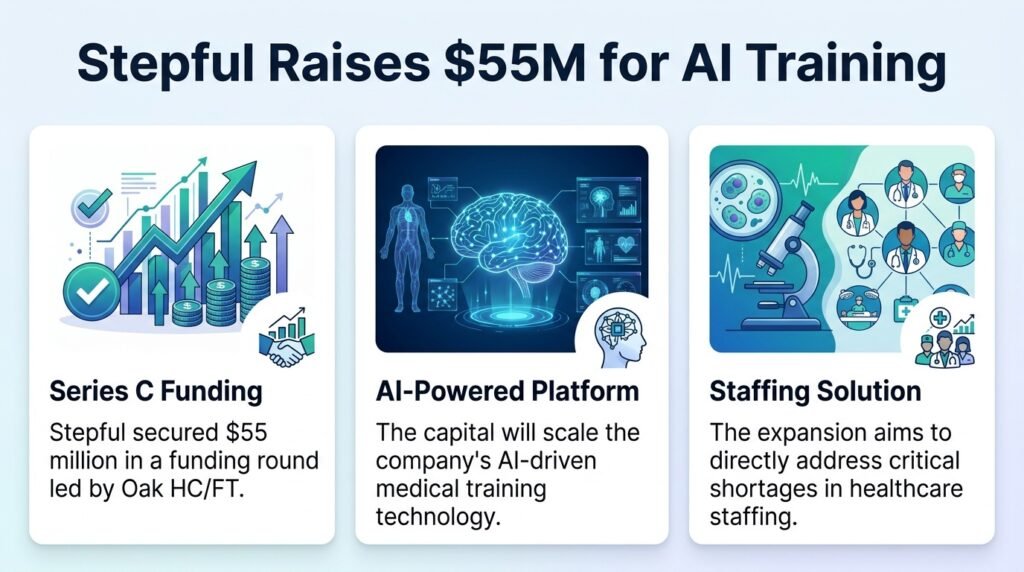
A new $55 million Series C funding round for Stepful signals a shift toward “school-as-a-service.” By moving vocational training online and using AI to manage workflows, the platform claims to train workers ten times cheaper and four times faster than legacy programs.
But speed introduces its own questions. Can virtual simulators and accelerated timelines truly replace hands-on clinical repetition?
Stepful has already graduated 32,000 workers for major systems like Mount Sinai. Now, it plans to use its $100 million total funding to expand into high-stakes fields like registered nursing and medical imaging.
The Quality Question
Scaling entry-level medical assistants is one thing. Training registered nurses online is a far steeper climb.
If accelerated digital models succeed in these complex fields, they will force a reckoning for traditional nursing schools. If they fail, health systems will face an even greater crisis of clinical readiness.