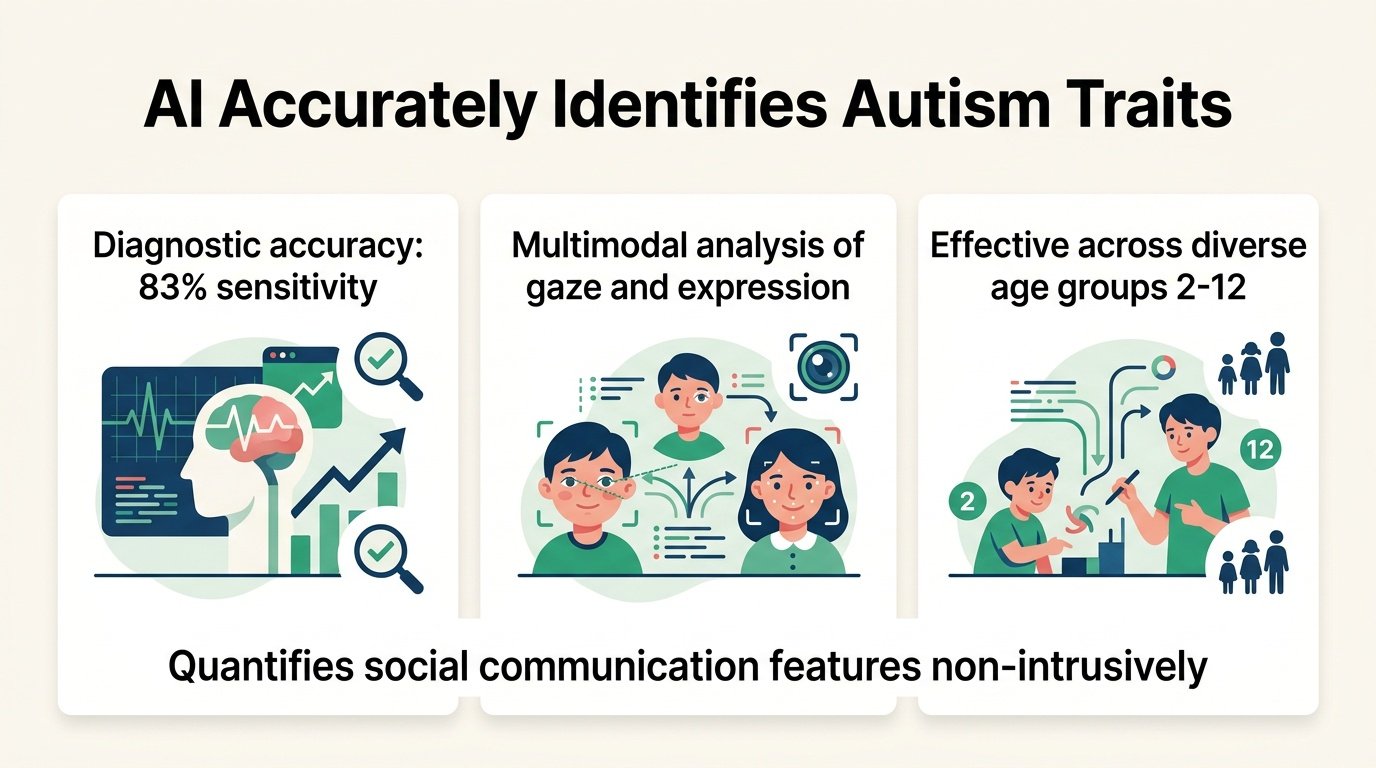
A new machine learning tool measures eye gaze and facial expressions during autism evaluations, but its struggle to distinguish autism from other developmental conditions reveals the limits of automated diagnostics.
Can a computer algorithm really capture the nuances of human social communication? Clinicians spend years learning to spot the subtle differences between autism and other developmental delays. This study attempts to automate that gaze and speech tracking, but the results show we are not ready to hand over the clipboard to software.
That gap is the real story.
Instead of a diagnostic replacement, this technology is a clinical assistant. It proves we can gather biometric data without invasive sensors. However, the drop in accuracy when facing non-autistic developmental conditions shows that machine learning still struggles with the messy reality of differential diagnosis.
Testing the algorithms
Researchers tested a machine learning tool on 546 participants aged 2 to 12 across four sites in the USA and Qatar. After filtering for audio and video quality, 458 participants, or 83.6%, remained for the final analysis. The team trained Random Forest classifiers using 97 biometric features from video, audio, and gaze data, tailoring the models to three distinct developmental speech levels.
What the data shows
The system performed best when comparing autistic children directly to neurotypical children, but its accuracy dipped when other developmental conditions were introduced.
- In the inner set of 338 participants, the tool achieved 77.8% sensitivity and specificity when separating autism from all non-autism groups.
- This accuracy rose to 82.0% sensitivity and specificity when comparing autism directly to neurotypical participants.
- In the independent hold-out test of 120 participants, sensitivity fell to 62.3% for autism versus non-autism, while specificity was 81.4%.
- For autism versus neurotypical participants in the hold-out set, sensitivity reached 72.1% and specificity hit 88.6%.
- Performance varied by sex, with males showing higher sensitivity of 79% to 75% and females showing higher specificity of 84% to 70%.
The clinical reality
The drop in sensitivity to 62.3% in the hold-out test set is a warning sign. It means the algorithm missed more than a third of autism cases when evaluated against a realistic clinical mix of patients. This is where the technology falters.
This limitation matters because autism does not exist in a vacuum. In the real world, clinicians must distinguish autism from ADHD, speech delays, and other neurodevelopmental conditions. A tool that excels only at telling autism apart from neurotypical development is of limited use in a busy clinic.
Rather than diagnosing patients, this technology is best suited for task-sharing models. It can quantify behaviors and flag patterns, helping clinicians manage heavy caseloads without replacing their expertise.
Read the full study in Frontiers in Psychiatry.