A massive meta-analysis reveals that while machine learning algorithms technically outperform traditional sepsis screening, the underlying data is too messy to trust in real-world wards.
Hospital wards are flooded with AI tools designed to spot sepsis before it kills. On paper, these algorithms look like an unqualified success. In practice, they are built on a foundation of statistical sand. This disconnect challenges the industry’s obsession with high performance metrics that fail to translate to the bedside.
A new systematic review in npj Digital Medicine analyzed 53 studies covering more than 7 million patient encounters. The researchers wanted to see if machine learning actually improves on-the-ground sepsis prediction compared to traditional clinical scoring systems. The raw statistical output suggests a massive leap forward.
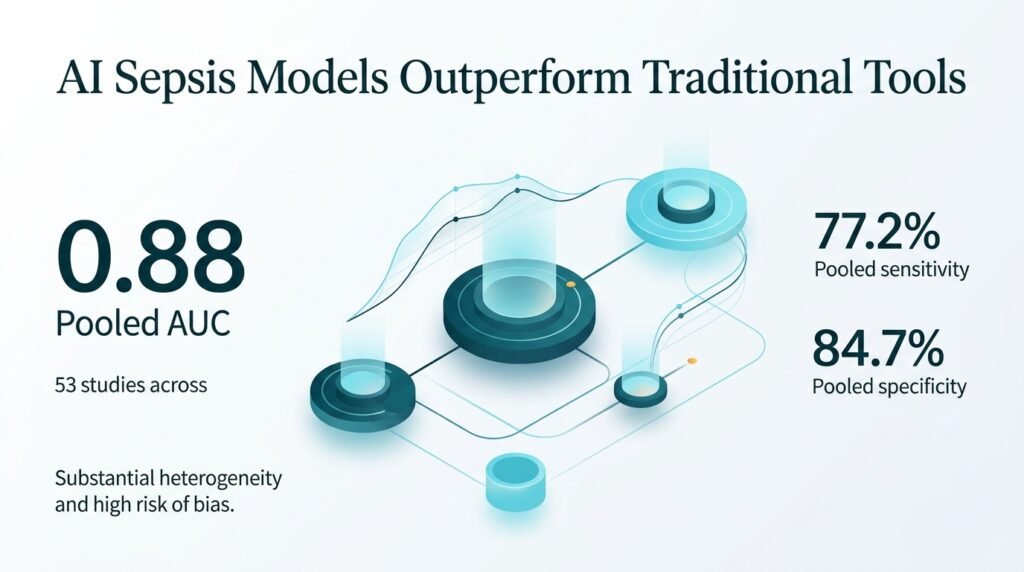
- The best-performing models achieved a pooled AUROC of 0.88 (95% CI [0.86, 0.90]).
- AI outperformed traditional screening tools by a mean difference of 0.119 (p < 0.001).
- The pooled sensitivity reached 77.2% alongside a specificity of 84.7%.
- Decision trees and ensemble models proved to be the most accurate architectures in the network meta-analysis.
The bias problem
These numbers suggest a clear victory for machine learning. Yet, the researchers found a glaring catch that complicates the entire narrative. Most of the analyzed studies carried a high risk of bias when evaluated with the PROBAST-AI tool.
Furthermore, heterogeneity was incredibly high, with an I² value above 95%. The 95% prediction interval was incredibly wide, ranging from -0.06 to 0.30. This means that in some hospital settings, the AI might actually perform worse than standard care, rendering the high average accuracy meaningless for individual clinics.
Why this matters
This is not just an academic debate. Sepsis is a leading cause of hospital deaths, and false alarms cause severe alarm fatigue among nursing staff. If an algorithm’s performance varies wildly from one hospital to the next, deploying it blindly is dangerous.
This analysis confirms a broader trend highlighted in The integration of artificial intelligence into clinical medicine, which warns that clinical integration is stalled by poor validation. To fix this, developers must adhere to strict reporting standards like the TRIPOD statement to ensure models are transparent, reproducible, and safe.
Until we have standardized, prospective trials, these high AUROC scores remain vanity metrics. We do not need more models. We need models we can actually trust when a patient’s life is on the line.
Read the full study in npj Digital Medicine.